Tuesday, 1 March 2022

Raymond Sheppard and Round the Year Stories: Autumn

Round the Year Stories: Autumn - cover

We have covered Spring and Summer and today we look at Autumn! The first article included a biography but a very thin one. So let's rectify that here:

Maribel Thomson was born 23 April 1895, in Aberdeen and she was indeed the daughter of Sir John Arthur Thomson and Lady Margaret R Thomson. She married Charles Frank Edwin, 11 years her senior, (born 27 February 1884?) and they settled in Surrey after marrying in St. John the Evangelist, Blackheath in the summer of 1921 (when she was 26 years old). Charles' father was also Charles Frank born in Worcester. Charles (junior) was born in Guildford Surrey and his speciality later in life was electrical engineering - not surprising he was practical, as his father was a watchmaker. They were living at "Sunrays", Milton Avenue, Westcott, Dorking in 1952 according to the Electoral Register, - there was auction of contents of that house in 1950 so perhaps we have a date range for the move there. I suspect Maribel died at the Garth Nursing Home, Tower Hill Road, Dorking, Surrey, on 25 September 1985 which would make her 90 years old. If I've got the right Maribel, probate was £139,077.

Anyway let's look at Raymond Sheppard's images drawn for this book.

Round the Year: Autumn, p.15
"Down came the dagger-bill in a flash" 
Heron attacking underbelly of a rat

Round the Year: Autumn, p.23
"He landed on the one spot that was rather like home to him"
Skylark on ground

Round the Year: Autumn, p.29
"Over and over rolled the two little animals"
Two shrews fighting

Round the Year: Autumn, p.37
"There was a terrific clash and rattle as the two pairs of antlers meet" 
Two stags do battle

Round the Year: Autumn, p.41
"The leader of the herd"  - A stag bellows

Round the Year: Autumn, p.45
"They flew swiftly and steadily away towards Africa"
Swallows flying

Round the Year: Autumn, p.51
"Lintie began to beat himself against the netting"
A linnet on wire mesh

Round the Year: Autumn, p.59
"Down shot Seep, followed closely by his enemy"
A redwing pinned down by a hawk

Round the Year: Autumn, p.65
"There was no fear of starving in this place" 
An otter climbs on bank with fish

Round the Year: Autumn, p.67
"Gyppo followed the trout wherever it went" 
Otter chasing trout

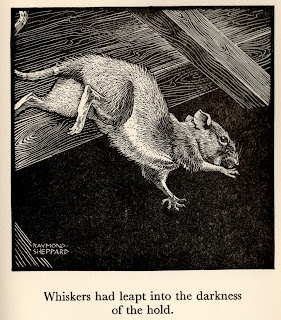
Round the Year: Autumn, p.75
"Whiskers had leapt into the darkness of the hold"
A brown rat leaping

Round the Year: Autumn, p.81
"He all but collided with a swallow" 
A swallow crashes into a wren

Round the Year: Autumn, p.89
"Buff twisted the tip of his tail round a twig"
A dormouse climbing foliage

Round the Year: Autumn, p.95
"Away went Bunny as fast as his legs would carry him" 
A rabbit flees from a stoat

Round the Year: Autumn, p.97
"Black-Tip sprang at the crow- and he hung on"
A stoat grabs a crow in flight while a rabbit watches

Round the Year: Autumn, p.103
"Tawny was at once set upon by a mob of indignant starlings, tits and sparrows"
Starling, tit and sparrow attack a tawny owl

Round the Year: Autumn, Frontispiece
"Franky pushed himself off and flapped slowly away"
Grey heron takes flight


 In an earlier article on this series, I showed some proof printings and how they differed so much from what was printed. Today I can show you the Frontispiece illustration above, so you can compare them. This was  for sale a while ago and I captured the image from the auctioneer's site.

The grey heron flying

Here's a link to all four Edwin versions:


Wednesday, 2 February 2022

Raymond Sheppard and Way for a Sailor

Way for a Sailor - Cover by Raymond Sheppard
 Peter Dawlish, the pseudonym of James Lennox Kerr (1 July 1899 – 11 March 1963), was a Scottish socialist author whose fame rested on his sea stories for young boys. He also used the pseudonym Gavin Douglas for his adult works with his last work found being published close to his death. Some of the "Dauntless" series were reprinted by publisher John Goodchild (of Wendover) in the Eighties with new titles..

It appears Dr. Stephen Bigger is the champion of Kerr's stories as he has blogged about the writer and also started the Wikipedia page. If you search the afore-mentioned blog for Lennox Kerr or Dawlish you'll see many entries. You can also access his e-print (PDF) of 8 pages on University of Worcester's site including two photos of the author and a bibliography.

Way for a sailor - Frontispiece
showing the harbour where Ronald starts his new life

I'm concentrating, of course on Raymond Sheppard whose sole work for 'Dawlish' was Way for a Sailor.  The blurb on the dustjacket reads:

Young Ronald McKay ran and fought and shouted as a small boy in the back streets of a Scottish industrial town—a natural leader, who on the strength of one highly coloured sea story, picked up by chance, becomes obsessed with a passion for the sea that he has never seen, and ships that he has only dreamt about. Way for a Sailor is a story of determination. It closes with Ronald about to go to sea as a ship's boy, for a summer holiday apprenticeship on a Scottish coast¬ing vessel; and by the time that we reach the last page, we have shared the boy's passionate longing for the sea, his stratagems to earn enough money to buy a share in a leaky old rowing boat, his conflict with his father and mother, and the whole bewildering, exciting business of growing up with one overriding ambition—to be a sailor.
Peter Dawlish has a distinguished name among writers of sea stories for boys, and much of his own boyhood has gone into Way for a Sailor. There is an urgency and conviction in this latest book, which carries the reader with it : it will command the interest of any boy who has ever thought of going to sea.
For other books by Peter Dawlish see back flap and back of jacket
Ages 12 and up Price (in U.K. only) 9s 6d net

Christine Sheppard still has the two bromides - proof copies of the illustrations from this book. My photos of them are crude and show them out of order compared to the published version:


I love the image of the frontispiece above showing the steep decline to the harbour. I'd love to know if it's a real place. I thought Robin Hood's Bay in Yorkshire a steep drop, but this image gives me vertigo! Note also the many details Sheppard has drawn - to the hree seagulls on the roof. I have to say the row-boat in the harbour looks to be wrong in size to me.

Way for a sailor - p.1
Ronald & friends enact battles

Way for a sailor - p.21
Ronald visits a terrifying place - the Library!

Way for a sailor - p.39
Ronald meets Mr Paterson - and his boat for £1!

Way for a sailor - p. 57
Ronald works hard to earn the £1

Way for a sailor - p. 87
Ronald, his dad and Mr Paterson meet

Way for a sailor - p. 105
Ronald & Mr. Paterson go out to collect flotsam

Way for a sailor - p.118
Ronald shows where everyone must sit in his boat

Way for a sailor - p.139
Ronald runs away from the town to sea

Way for a sailor - p.146
Ronald hides and gets a lift to the coast

Way for a sailor - p.168
Ronald makes new friends on board the schooner

Way for a sailor - p.186
A dare goes wrong for Ronald

Way for a sailor - p.201
Ronald's new 'friend' hides him in the dirty hold

I found a review of the book - children's books had few places to be reviewed! - in the Boy's Own Paper of February 1956 (p.31) which gives a good account of the story, including the beginning which soon gets forgotten as we follow the child version of the Commodore!

Boy's Own Paper Feb 196, p.31


Monday, 10 January 2022

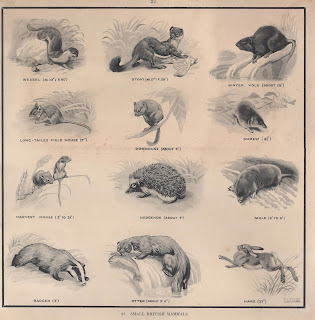
Raymond Sheppard and Small British Mammals poster

Small British Mammals poster

Small British Mammals is plate #27 in a series of school posters I had not seen before. Previously I've shown Two Years in the Infant School (Box 1 Topics 1-63) by Enid Blyton and also Macmillan's Teaching in Practice for Infant Schools (Projects and pictures).

The mammals portrayed are: weasel, stoat and water vole in the first row; long tailed field mouse, dormouse, shrew, in the second row; harvest mouse, hedgehog, and mole in the third and finally the badger, otter, and hare. The poster measures 13.5" wide by 14" tall.

The only reference to this I could find was an old eBay sale mentioning a second black and white poster of "Goldfish and Queensland Salmon" - the latter appears odd to me for a UK school! The seller ran the headline  they were part of a set of 142 posters, which appears too big to me for any classroom purchase as others are in the 50s and 60s.

If I get any further information, I shall amend this entry.

Tuesday, 21 December 2021

Raymond Sheppard and the Christmas Crib

 We've looked at the two series at either side of Christmas 1957 which appeared in the children's comic Swift (from the Hulton Eagle stable) before. Today is the right time to wish all my readers a very MERRY CHRISTMAS and a HAPPY NEW YEAR!

If you have some time on your hands you might like to reproduce the 6 part Christmas Crib - as published in Swift from 9 November 1957 to 14 December 1957 issues. Please excuse the colours being a bit off as I didn't scan these and don't own the comics. But I have added two photos I took of cuttings I've seen, so you can see how the colours should be!


and the two photos:


On the second of November 1957, "Animals and their young" ended, we then get the crib above until 14 December, followed by "Christmas dinner for the birds" and the robin Christmas card. In the new year, on 4 January 1958, the "Birds and their nests" series started.


Wednesday, 1 December 2021

Raymond Sheppard and Argosy Magazine (UK)

The Argosy magazine started in the USA, and you can read about it here, but as far as I know Sheppard never did any illustrations for this magazine. His drawings appeared in the UK version of Argosy published by Amalgamated Press, which was first published in June 1926 (by Cassells for the first year before AP took it on). The small pocket sized magazine was printed monthly on pulp paper through most of its life and featured stories from around the world. Latterly it began printing new stories. 

Tracking down illustrators in Argosy is hard enough when most of the time they are not credited, but during the Fifties there was a time where credits appeared in the contents page, but not all credits! I also found some illustrations re-used years after Sheppard died in 1958! So for the moment this is the most comprehensive listing of Sheppard's work in Argosy!

The earliest I've found so far is a story by Tom Hopkinson (it's likely the same Hopkinson who worked with Stefan Lorant on Lilliput and Picture Post) called "North of Midnight" about post-war Finland, and a construction engineer called Garrod whose objective is to replace three vital bridges destroyed during the war. His encounters with the Laplanders are the meat of the story and Sheppard illustrates a reindeer with full antlers and also a reindeer pulling a sledge.

Argosy January 1955 p.29

Argosy January 1955 p.43

Argosy January 1956 has a jungle story by David Walker called "Harry Black" which was serialised over three issues. The book was first published by Collins in 1956, so this is hot off the press! A film starring Stewart Granger was also created in 1958. Sheppard provides an image in Argosy (not the book)  of the head and front of a tiger coming through long grass and a profile of a tiger leaping, 

"This is a novel with atmospheric tension. The end impression [is] that of a first rate adventure against the sultry background of of a man-eating tiger. Black, a war hero, [faces his own cowardice]. Difficult reading at times, the [story is] told against an elusively presented past and a romance between Black and Tanner's wife. But hunting story fans will like it." ~ Kirkus Review

Argosy January 1956 p108

The above image is repeated on page 123 too. They are both interesting in that, even with the rough printing, they appear very 'scruffy' in my opinion. I almost wonder if they are reprints from something earlier.

Argosy January 1956 p.109

The two images above of the tiger also appear in the second instalment in February 1956 (the leaping tiger p.105 and the crouching tiger p. 143). I have not seen a copy of the March instalment and no illustrations are listed on the incomparable FictionMags Index (edited by William G. Contento and Phil Stephensen-Payne). 

Argosy January 1957 p.69

The January 1957 issue has an image on p.69 to accompany the beautiful story "The Christmas Miracle" by Paul Gallico that recounts the capture of a settler family by a band of Indians in pre-revolutionary America. The victims’ demise seems all but certain, but it’s the 24th December and miracles can happen… I don't need to say anything about Gallico as his stories are still in print as are those of the next author to be illustrated by Sheppard: H. E. Bates.

Argosy October 1957, pp.102-103

The story, "A Great day for Bonzo" warranted a headline on the cover. 

Argosy October 1957,Cover

 The H.E.Bates Companion tells us:

this novella-length piece is experimental in style. The narrator recalls a day-long adventure with two other children, in which they unintentionally find themselves involved in an ugly domestic conflict, with overtones of death and tragedy. A television adaptation (episode four in the 1974 series "Childhood") was directed by Michael Apted

Argosy October 1957 p.124

Argosy October 1957 p.143
Three children find themselves unwittingly at the center of an adult drama involving a woman, the man she wants to marry, and her angry, violent father. Bates brilliantly manipulates the point of view, keeping it limited to a child's perception yet fully developing the conflicts and passions the children do not comprehend. ~ H.E. Bates: A Literary Life, by Dean R. Baldwin 1987

Next we have a story from the Netherlands by Jan de Hartog, "Gaudy Palace".  de Hartog ran away from home when 10, we are told, later entering the Amsterdam Naval College and finally started writing short stories after being expelled "This school is not for pirates!" he was told. His adventures at sea gave him a lot of material. 

Argosy November 1957 p.69

This story is about the need to preserve a Governor's life in Tarakan, Borneo as he was the only person who spoke Dutch! The Doctor who attends encounters someone faking his illness, but why would the Sultan do that? 

The January 1958 issue of Argosy has an unusual double page spread topped with an illustration of two pigs on a picket fence and finished off with a sow and her piglets! The whole thing is reproduced here. 

Argosy January 1958, pp.62-63