Showing posts with label Magazines Everybody's. Show all posts

Tuesday, 1 July 2025

Further Everybody's illustrations by Raymond Sheppard

Today's article is about women whose names have been captured in history but who perhaps are not so well remembered now.  

Everybody's 18 December 1954 (pp34-35) "First Lady of South Africa" by D. L. Hobman

Everybody's 18 December 1954 (pp34-35)
"Poetess, diarist, hostess, friend of the famous –
Anne travelled to remote Boer farms with her husband
in a creaking ox-wagon. She has become one of the most
remarkable women in British history"

The first illustration by Raymond Sheppard for this article is the fascinating tale of Lady Anne Barnard. The oval portrait shown here is credited on Encyclopedia Britannica as being "after a miniature by Richard Cosway" and the National Portrait gallery has it as "Walker and Cockerell after Cosway" which seems to be a more complete reference.  They also have the portrait of Andrew Barnard "by Charles Turner, after Sir Thomas Lawrence, mezzotint, published 1809"

The double page spread by Sheppard shows Anne and husband trekking across South Africa. The article starts:

TWO pretty Scottish sisters, accustomed to sharing every secret, exchanged confidences about the man with whom Margaret, the more beautiful of the two, had fallen in love. Anne, the elder, more gifted sister, was full of sympathy, but not so their parents when the affair became known. The suitor was consequently sent overseas and instead, according to eighteenth century fashion, a match was arranged on Margaret's behalf. Alexander Fordyce was a wealthy banker, considerably older than the bride. He took her away to live in London and Anne was left sad and alone. In order to console herself she made up a poem about a young girl married to an old man, to be sung to a well-known melody, instead of the improper words sung to it before. The last verse ran:

I gang like a ghaist, and I carena' much to spin, I darena' think o' Jamie, for that would be a sin. But I'll do my best a gude wife to be, For O, Robin Gray, he is kind to me.

This song, Auld Robin Gray, soon became wildly popular and was used later as the subject for a play, an opera, and even a pantomime. Yet in spite of such immediate and lasting popularity nobody knew who had written Auld Robin Gray until Anne, shortly before her death, admitted authorship in a letter to Sir Walter Scott. She told him that she had felt melancholy and had tried to amuse herself "by attempting a few poetical trifles ... At our fireside and amongst our neighbours Auld Robin Gray was always called for. I was pleased in secret with the approbation it met with; but such was my dread of being suspected of writing anything, perceiving the shyness it created in those who could write nothing, that I carefully kept my own secret." Such was the modesty of Lady Anne Lindsay, born in Fifeshire on December 8, 1750. She was the eldest of the eleven children of the fifth Earl of Balcarres.

When she finally married at 42, the groom was 30 years of age. Her husband's acceptance of the job of Secretary to the Governor (whose wife did not accompany him to South Africa) meant in 1797 the couple were part of the scene where Dutchmen reluctantly accepted British rule. She soon shone and enticed the children of the Boers to social occasions and won many hearts.  

The authoress of this article led an interesting life herself - Wikipedia again comes to my rescue.
 

Everybody's 2 April 1955 "Betty Mouat's adventure" by J. M. Scott (p.16)

Everybody's 2 April 1955 (p.16)
"'Columbine' was drifting fast before the strong wind. And night was coming on"

Rather than just point to Wikipedia - which does have a page on Betty's adventure, I'd recommend Claire White's outline with a song too about Betty, which is delightful. Betty Mouat, from Shetland, was the sole passenger sailing to Lerwick in order to sell her knitwear. Unfortunately the storms in the North Sea took the boat and the captain was washed overboard. Poor Betty - then aged c. 61, was alone on a boat tossed here and there at the whim of the weather. It took 8 lonely days in which she used all her supplies - a bottle of milk and two biscuits. Finally she made the rocks off the coast of Norway and was rescued by fishermen. Her name is commemorated by a plaque in Lepsøya but her return to Edinburgh via Hull, meant her fame was widespread. Betty's  journey certainly captured the public's imagination in 1886 and Queen Victoria was involved too!

I think Sheppard captures the roaring wind and waves that washed over the boat, and his image of Betty holding on - determined to survive - works really well. The angle of the piece adds vertiginous feelings for the viewer.

Sunday, 1 June 2025

Everybody's magazine continued


Everybody's 24 April 1954 p.25
"The trout rushed hither and yon... and leapt skywards after June bugs and mayflies"

I've updated Playing For The School as I've been sent the cover, which was indeed drawn by Raymond Sheppard 

Anyway today's assortment of images are from the weekly magazine Everybody's, published in the UK - with Raymond Sheppard illustrating many articles and stories during the 1950s. The first is from:

Everybody's 24 April 1954 (p.25) "The chastisement of Horsey" by Kerry Wood

The "true story is about a bull-frog, a big fish and a Mr. G. G. Brown, known as Horsey" starts the tale. We learn of how the frog, knowing he must be very careful not to wash himself near the deep pool where the trout monster lives, keeps himself stuck to the high rock. But along comes a Mr. Brown to fish on his land which includes "Snob Creek". The frog and the trout have a harmonious relationship - if the frog misses a fly, it dips down and gets caught by the trout. They are grateful to each other. The tale ends with Mr, Brown catching the large frog in his hands and trying to wash it over the deep pool. The trout springs and bites into Mr. Brown's hand which releases the frog! Mr. Brown took up horseshoe pitching instead of fishing.


Edgar Allardyce Wood C.M. (2 June 1907 — 25 July 1998) - Kerry Wood was his pen-name - was a Canadian who wrote many books and articles published around the English-speaking world.   

Short bibliography

Christine Sheppard shared these sketches by her father and I love the quickness of Sheppard's line work in some of these - reminding me of his advice when drawing moving animals and birds, don't worry they are not like still life, but they will most likely return to the same position at some point.

Pencil sketches of frogs - Raymond Sheppard

Everybody's 31 July 1954 "Desert Aristocrats" by Joseph Braddock

Everybody's 31 July 1954 p20

The illustration above illustrates  a large group of Arab hounds (Saluki) and a separate illustration of an Arab rider on a rearing horse. The article by Braddock tells of the history of how the Arabs bred horses so finely as well as the hunting Saluki - this is to accompany a show at the Roehampton Club, London where both would appear in 1954.

Everybody's 21 August 1954 "Ghost ships of the arctic" by Larry Forrester 


Everybody's 21 August 1954 p14

"The explorers staggered into a blizzard and oblivion. Their ships may still be afloat" is the title above Raymond Sheppard's drawing showing a group of men forcing their way headlong through a blizzard, with one of the men on crutches! The tale is that of HMS Terror and HMS Erebus as they tried navigating the Northwest passage. The article also has a photo of Sir John Franklin and also a picture of the Erebus stuck in pack ice by T. Picken (after I E Davis). The next page has a copy of "the bottle paper" which was found in a cylinder plus a mezzotint of Sir Leopold McClintock If you don't know the story, Wikipedia has an excellent overview and the BBC dramatised it with The Terror starring Ciarán Hinds. The two missing ships were not found until 2014 and 2016 - 170 years after they set out!

It appears that Larry Forrester, (1924-1988) wrote at least 7 books and more popular were his screenplays - see Mubi for more details which confirm he wrote several early ITC TV production episodes and more famously the 1967 film "Tora! Tora! Tora!"

  • Unsolved Mysteries: A collection of weird problems-from the past. Edited by Valentine Dyall, London: Hutchinson, 1954
  • Fly for your Life: The story of R. R. Stanford Tuck, London: Frederick Muller, 1956
  • Skymen: heroes of fifty years of flying. London: Collins, 1961
  • A Girl called Fathom. London: Heinemann, 1967 [See Wikipedia]
  • Battle of the April storm. London: George G. Harrap & Co., 1969
  • Three great air stories: Reach for the sky; Skymen; The man in the hot seat. London: Collins, 1970
  • Diamond Beach: A novel. London: Harrap, 1973

But could he also have written the story for a Star Trek: The Next Generation magazine (vol. 4, April 1988) "The Battle" adapted from the TV script by Herbert Wright, with the story by Larry Forrester?

Next time: I'd like to show more Everybody's illustrations

===============================

The Kerry Wood photo and bibliography are taken from Something about the author by Anne Commire, Detroit, Michigan: Gale Research, 1980 


Monday, 13 January 2025

Raymond Sheppard and various Everybody's illustrations


Everybody's 2 January 1954 p.11
Today I want to carry on looking at Raymond Sheppard's work in the weekly large format  Everybody's magazine.

"Long, Long Trail of the Eskimo Killers" was written by Roland Wild (in an interview with Constable of the Withers of the Royal Canadian Mounted Police)  and we see the half page illustration above with the caption "Slowly they were surrounded by a ring of impassive men and women, who could kill them in an instant". The story is of how the phrase "The Mounties always get their man" came about and is based in 1915-1916.

I found out that Roland Gibson Wild was born in 1903 in Manchester and died in 1989 (aged 86) in North Vancouver, British Columbia where he was a respected newspaperman, wrote 13 books - working on another at his death - and had the dubious distinction of hitting the Prince of Wales with a "surprisingly long drive" while playing at Britain's Sunningdale golf course.

Everybody's 3 April 1954 p.17

In Everybody's 3 April 1954 "The last stampeders" we have the second tale by Roland Wild. he tells, over two pages, how the survivors of the Klondike Gold Rush meet up. Writing in 1954 he mentions that the 400 men and women present "are a race apart, living on the memories of fifty-six years ago". He then recounts some of the factual stories but mostly tall tales of the "Stampeders". Sheppard's illustration shows one very great legend, whose stories seem to change over time, that of 'Soapy', the bandit prince of Skagway, as he orders "the guards to jump into the river. Both guns cracked". We see three men jumping into river near a boat while two men face each other with rifles. As one Yukonner admits, the tales get "taller and taller".

Everybody's 2 January 1954 p.15

You really need to click on the above picture to enlarge it, in order to see the fantastic detail. Not only has Sheppard drawn historic costume but also rigging on the ship and even rats who are obviously leaving the sinking ship! The two page article is called "When the 'Royal George' sank" and is written by Oliver Warner, appearing in Everybody's 2 January 1954, the same issue as the Eskimo illustration above. Sheppard's single colour illustration takes up half of the second page.The caption describes the scene  "In addition to her full company, the ship was crowded with wives, sweethearts, children and hucksters. Disaster struck with a suddenness so horrifying that even rats came panicking out of their holes. The cannon burst from their moorings and in a moment hundreds were drowning". This is the story behind William Cowper's poem which "does not tell the whole truth about the loss of the 'Royal George' ". This ship was the largest warship in the world at the time of her launch on 18 February 1756 and after seeing action 

on 29 August 1782 whilst anchored off Portsmouth, the ship was intentionally rolled (a 'parliamentary heel') so maintenance could be performed on the hull, but the roll became unstable and out of control; the ship took on water and sank. More than 800 people died, making it one of the most deadly maritime disasters in British territorial waters. ~ Wikipedia

Oliver Warner (1903-1976) is a well-known naval historian and writer and a bibliography of his books is on Wikipedia. If you want to read more about the incident, Roy and Lesley Adkins have written on Lloyd's Register Foundation Heritage and Education Centre's site.

Thursday, 19 December 2024

Raymond Sheppard and more Everybody's illustrations

Everybody's 25 April 1953 p.23 

Everybody's 25 April 1953 p.34

This rather tame illustration of two boys who help "Old Elmer", a beaver by supplying wood for him to build his dam is not the best Sheppard illustration. The problem is they are late for school every morning and the school report is due any time by post. How to make sure Dad doesn't see it? Why, hold up the mail coach of course. They manage to fumble their way to finding the specific letter but by then, yes you've guessed it, their dog has grabbed it and heads home. 

"Report Stage" was written by James McCormick and appeared in Everybody's 25 April 1953 and he also wrote another tale, I have, which was illustrated by Sheppard, called "Lion's Share" which appeared in the same year in 26 September issue

Everybody's 26 September 1953 p.28

The caption reads "He spotted us alright – and he'd spotted the rifles too" and the illustration shows Sheppard's talent off to the full with a herd (is that the right word?) of stallions and their young running towards us. I count seventeen animals plus five on the rise! The story is about a 12 year old who visits his Grandpa who should "live on 4 legs" according to the boy's 'Grandmaw' and a specific horse, "Baldy" who "had a broad white blaze down his face and the rest of him was a lovely golden brown". Baldy was known to be able to spot a gun and head off up to tall timber to escape and that's what he does despite the presence of a cougar which the man and boy spot. 

Both stories make me think McCormick was American but one line in this story makes me suspicious: "You could have lost a couple of English Counties in them easily". Was he like many writers at the time based in Britain and using Wild West genre to inspire them to write? I have no other magazines with his work illustrated by Sheppard so there may more out there, but he's a complete mystery to me.

Everybody's 28 November 1953 p.30

Moving on the next image I want to share is from a short story written by the prolific author Alan Jenkins. "Ad Infinitum" appeared in Everybody's 28 November 1953 and Sheppard's drawing shows a woman on platform speaking to crowd while being filmed with the caption “And now Dr. Grimble showed us the most terrible thing of all”. It's a nice little science-fiction story about a reporter visiting Doctor Felicity Grimble at the brand new Ribbleswick Atomarium where a "ultra-microscope, an observatory for studying the motion of atoms and electrons" was being shown off for the first time. In fact Dr. Grimble shows them life on an electron by slowing the film down and comments that we are like that electron. Other larger beings outside our know universe are observing us as we have just observed the life on an electron - with all that that entails for religions and ethics! An interesting tale.

Monday, 7 October 2024

Raymond Sheppard and Alexander Lake in Everybody's


Everybody's 21 August 1954 p30

Alexander Lake (29 July 1893 - 25 December 1961) was born in Chicago, Illinois and moved to South Africa with his family in 1908. Due to his great marksmanship skills developed at school in a shooting team, he was hired as a meat hunter by the trader Nicobar Jones. This job took him to Portuguese East Africa, Tanganyika, Kenya, Uganda, Northern Rhodesia and German Southwest Africa. Within a couple of years he was a fully-fledged and licensed white hunter. ~Taken from Shakari Connection

I've been looking at the drawings accompanying Alexander Lake's run in Everybody's magazine, appearing in 1954 and which are all reproduced below. Lake, (whose middle name appears to be James) wrote mainly about hunting in Africa and is quoted with Jim Corbett, - unfairly in my opinion as the latter was a conservationist not a hunter per se - when writings like these are cited. After being written and published in English, many of his stories were published in Spanish and Italian throughout the later half of the fifties and the sixties.

In the first of 5 instalments, titled for the magazine as "The jungle is my business", Alexander Lake's second book, published that year, African Adventures is adapted with accompanying images drawn by Raymond Sheppard. The headline on the cover "by one of Africa's greatest hunters".

Everybody's 24 July 1954 (pp14-15)

The first part appeared in Everybody's under a cover about Wilfred Pickles' popular show "Ask Pickles".  Everybody's 24 July 1954 (pp14-15, 16) shows Sheppard's illustration of drunken apes. "By mid-morning nearly every adult ape was staggering about hopelessly. My Basuto boys leaped among the helpless drinkers" reads the caption. The following page shows a cropped image of the drum from which the apes are drinking. 

Everybody's 24 July 1954 (p.16)

The second episode  has the dramatic lion leaping

Everybody's 31 July 1954, pp30-31

Everybody's 31 July 1954  has the fantastic title "Mussolini shot a lion he never saw!" with a corresponding clue in Sheppard's illustration as to what the title means. A lion in full flight races towards a cameraman as Alexander Lake raises his rifle - some filming! The caption reads: "I shot the lion in mid-jump. I heard the thud of the bullet as it hit, but he never faltered".  The story tells of how Lake signed up to help the photographer (Gennaro Boggio) for the Italian Ministry of Education get a great shot of a lion  being killed by the mighty hunter Il Duce, Mussolini without him being anywhere nearby. Lake's figure was to be dubbed in Italian and not shown as that might give the game away!
 

Everybody's 7 August 1954, p.31

Everybody's 7 August 1954 has another episode - this time called "Quicksands of death" in which Kees Jonker, an entomologist in "the Gaboon district of French Equatorial Africa" has to conquer his fear - of all things - of insects! When he accidentally encounters a giant West African spider on his face, he screams, runs pulling it off, and heads straight into the quicksand at which the men are camped. Thus we see the picture drawn by Sheppard. “I dug my feet in, leaned forward and pulled... I pulled until my ears ached...I heard Jonker yelling but he seemed miles away”

Everybody's 14 August 1954, pp.30-31

In Everybody's 14 August 1954, pp.30-31 we see another adventure in the series "The Jungle is my business" called "Drug madness in the Congo". We firstly have an image stretched across pp30-31 showing the caption “Bwana”, Wabo hesitated then blurted angrily: “If you wish it, I will put a spear through the back of this Bwana Poullet”. Lake is sat at the table as his helper opens the door and light floods in on Lake. The second picture is of Alexander Lake with a rifle on a horse approaching a snarling dog and vulture. The caption tells us: "Jenssen's big white boarhound fought to keep the obscene vultures away". I'm surprised the vulture is still sitting there with such a ferocious attacker near by.


Everybody's 14 August 1954, p.30

The last story, (Everybody's 21 August 1954 p30) taken from his book African Adventure, is called "The Man-Killer Dogs of Africa" and the image appears at the top of this article with a caption: "Those animals I'd dropped were torn to bits by the pack as Faure led on. But there were only five shots left – and twenty-five dogs" and shows a man holding high, his box of morphine and Lake aiming at the dogs. Thankfully Sheppard was not a literalist who had to draw 25 dogs!

Alexander Lake

 ALEXANDER LAKE BIBLIOGRAPHY

  • "Corner in Apes", Short Stories September 25 1935
    "Blood of the Snake", Short Stories October 10 1935
  • "Man-Eater!", Jungle Stories, Summer, 1941
  • "Pygmy Peril", Jungle Stories, Spring 1942 
  • "The Thunder God Burst", Jungle Stories, Summer 1942 
  • "Killer Elephant", Argosy December 1951
  • "The Truth About African Hunting", Argosy August 1952
  • Killers in Africa : the truth about animals lying in wait and hunters lying in print. London: W.H. Allen, 1953
  • African Adventures London: W.H. Allen, 1954
  • Hunter's choice; true stories of African adventure. Garden City, N.Y.,: Doubleday,  1954
  • "Boots in the Face" (with Nicobar James), Adventure August 1955
  • "The Monster of the Congo" (with Nicobar Jones), Adventure September 1956

I don't know if it's the same Alexander Lake who later produced two books containing short stories of prayers being answered but I suspect they are one and the same.

  • Your prayers are always answered. Kingswood: The World's Work, 1957 
  • You need never walk alone. New York: Gilbert Press, 1959

From: Killers in Africa (1953):

ALEXANDER LAKE spent much of his boyhood in Africa, where his father was a missionary. An excellent shot, Mr. Lake was persuaded to turn to professional meat hunting after Nicobar Jones, one of the world's greatest hunters, had seen him make an unusually high score with a rifle. Mr. Lake became an expert on animal habits and a thorn in the flesh of nature hunters after scouting the African jungle for twelve years. He has written countless articles and stories under various pen names for many national magazines. [Emboldening mine]

This appeared in:

How Your Prayers Are Always Answered came to be written
IN 1910, when I was seventeen, the South African colonies joined to become the Union of South Africa. Louis Botha was appointed National Premier by the King of England. The question of a native policy for the new Union was vital and pressing, and Botha, and other prominent South Africans such as Generals Jan Smuts and Christian De Wet, occasionally came to the Johannesburg home of my missionary father, Dr. John G. Lake, for advice.
These men always knelt and prayed before starting discussions, ending the closed each meeting with a prayer of thanks. Sometimes they'd sit for a while, telling stories of answers to prayer. Some of the answers were so remarkable—and made so deep an impression on me—that I began a life-long hobby of collecting prayer stories.
Whenever—anywhere in the world—I hear of some outstanding answer to prayer, I check the story; interview all concerned; dig out any data connected with it; write detailed notes and file them away.
From a collection of more than 2,000 such stories—all remarkable, fascinating and inspiring—I selected those that seemed to me to have the simplicity, directness, and the human and spiritual qualities so needed by people of this seemingly chaotic and insecure world of today.

I suspect we are yet to discover many of Lake's pen-names but hopefully this gives future researchers a starting point.

Thanks as usual to various websites and Phil Stephenson-Payne's site

Wednesday, 20 September 2023

Raymond Sheppard and Brian Marks' found artworks (Part Three)

Brian Marks (Part One) is here
Brian Marks (Part Two) is here

Now we have the other artworks which are lovely but have nothing to help me identify them - those who know me, know that won't stop me commenting! The collection comes from Brian Marks' father and is in such good condition. Same thing as last time, I'd recommend going to his Flickr account if you want to see these in hi-resolution as I've uploaded a smaller size here and downloaded the best version for my records

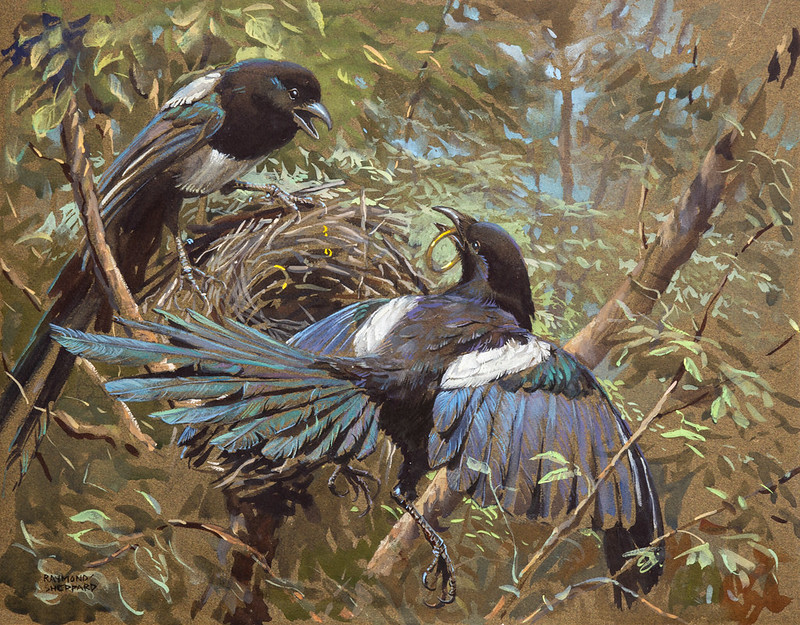
Magpies on nest, Raymond Sheppard
38.5 cm x 30 cm

Magpies and gold ring
I love the clarity of the offering from one magpie to another of a gold ring to join the others sketched in within the nest. The woodland recedes in the background is a very sketchy manner. But those birds show Sheppard's observation skills and I recently surprised my Grandson, they do have blue on the feathers!

Prone body
36.5 cm x 26.5 cm, Pastel, unsigned Raymond Sheppard

Prone figure

I have good news here. It took me a while but I found it in my collection of published work: Everybody's 5 December 1953 has a story "Ship with a cargo of murder" by Captain R. Barry O'Brien and the image heading up the story shows this prone body in place!

Everybody's 5 December 1953, p.30
It has a caption: "Almost before the Captain could cry out Big George had stabbed him twice and the other Greeks had disposed of the mate". It's very interesting to see that Sheppard has used one medium for the sketch and put so much detail into it. And I think I'm right in saying, it looks like Raymond Sheppard himself modelling for the prone body!

Tiger cub
22.5 cm x 18 cm, unsigned Raymond Sheppard , board

Tiger cub
Again I can comment here. Christine has in her cuttings collection an example of a Christmas card with - you guessed it - this very tiger cub. It also was signed and produced with a single colour

Coloured Christmas card with tiger cub

Lion, Raymond Sheppard
28.5 cm x 53 cm

Lion

Lion and Puff Adder, Raymond Sheppard
34.5 cm x 44.5 cm, "Lion and puff adder, Africa"

Lion and Puff Adder (Africa)

Both of the above lion images are interesting as they look to be drawn around the same time, same media, same paper. The subjects are common to Sheppard's work. Art Directors knew he could produce exciting shots of animals in situ. But I have no other information on these, but wouldn't be surprised to find they were published somewhere, early on in his career. 

Fox in Woodland, Raymond Sheppard
44 cm x 37.5 cm deframed painting

Fox in woodland

Christine Sheppard owns many images of woodland scenes - quite a few created around Mill Hill, London. But I must say this is the most interesting due to the branches drawn on the landscape here.

So finally we come to how Brian has these images to share with us.

It started with a cold call email - which I am happy to receive - saying 

"I have several Raymond Sheppard pictures. They belonged to my father, who kept them under his bed for 50 years. They are not in great condition and I am wondering what to do to preserve them, or perhaps get some of them restored. if the value justified that." 

I don't know anything about preservation except to say keep a lot of artwork out of sunlight! But when it came to seeing the images, of course I was super excited. here's the story:

"In brief, the work was given to my [late] Dad when he left lodgings in the artist's house. He rented a room there in the years after Raymond's death."

"At the age of 26 in 1959 Dad concluded his service in the army and secured a job in London at GEC. We believe a colleague from work suggested that he reside where he was staying, which happened to be with the Sheppards. I discovered a telegram addressed to the Sheppards notifying Dad of his own father's passing, dated 1962, indicating that he lived with them for a few years.  He met Mum around 1964, I believe, at a point when he had already moved out of the house but likely remained in the vicinity"

Christine mentioned the following:

"I certainly remember Ron Marks very well when he lodged with our family (my mother and brother and I) from 1959. He was a very kind man to us all and we spent quite a lot of time together. As I remember it, he had lived in Sidmouth, Devon and his mother came to stay with us from there at least once for a little break. He worked at GEC a short bus ride away in Stanmore and his work colleague whose name I cannot remember also lodged with us"

I'm so grateful to Brian, his Mum and Christine Sheppard for their interest and kindness in adding to the story. Brian also sent along some photos of the time his Dad was staying at the Sheppard's home which pleased Christine no end as she remembered Brian's Dad well.

Friday, 18 August 2023

Raymond Sheppard and Brian Marks' found artworks (Part One)

I have had a lovely surprise when Brian Marks contacted me to share a story:

I have several Raymond Sheppard pictures. They belonged to my father, who kept them under his bed for 50 years. They are not in great condition and I am wondering what to do to preserve them, or perhaps get some of them restored. if the value justified that.

Brian then suggested he could give me access if I was interested!

The collection is on Flickr at hi-resolution and different sizes to download. I've just placed some smaller versions here, so do go to Brian's site for the glorious detail!

"Buffalo and Tiger"

Buffalo and tiger, Raymond Sheppard
40 cm x 31.5 cm, ROUGH for "I shot the devil tiger" "He had avoided those terrible sabre-tipped horns by inches"

I suspect this comes from Everybody's 19 January 1957 story "How I killed the devil tiger" by Ivan Cameron. The illustration appears on page 23 with the caption "I lay completely still under the tiger. Then, charging towards us through the grass, came a buffalo. He had spotted his natural enemy" - note the man on the right pinned down! I could be wrong in my attribution but do wonder if the original was a sketch given to an Art Director who asked for a changed perspective. But I have to confess the words "sabre-tipped horns are not present in the published version!

Everybody's 19 January 1957
And coincidentally I have a photo of the original art which shows the proposed title was going to be "I shot the devil tiger" before publication as "How I killed the devil tiger".
Original art

Flash the Otter, Raymond Sheppard
42 cm x 31.5 cm Young Liz?(Feb), "Flash the Otter"............suddenly he twisted and bit the fish behind the head.

Young Elizabethan February 1957 p.19

This is an easy one as I've shown this in its full glory before. It comes form the magazine "Young Elizabethan" February 1957 on page 19.

Foxes, Raymond Sheppard
37 cm x 27.5 cm, Young Elizabethan, Illustration to "Who'll feed my cubs" "Each time he carried a plump cockerel"

Original art

This story was published in Young Elizabethan September 1957 on page 10, as can be seen below. It was titled "Who will feed my Cubs?" and written by Mary Henderson.The caption on the original art was not used but highlights which part of the story is illustrated.

Young Elizabethan September 1957 p.10

Trap in the Tide, Raymond Sheppard
42.5 cm x 29.5 cm

Original art

Brian has found this already, but for his pleasure it was published in July 1955 in Lilliput in an article labelled "Trap in the tide" written by Malcolm Monteith and looks like this. Notice, as I've observed elsewhere the colours don't quite reflect the original art which is lovely to see.


Lilliput July 1955, pp48-49

African Buffalo? Raymond Sheppard
23.5 cm x 17 cm, Lilliput July Page 43 MONO

Original art

This comes from "The big bull" by Neil Ewing (Lilliput July 1955, page 43) where two other images are drawn by Sheppard (that's for another time). Text wraps in two columns around the African buffalo - notice the size prescription on the original art "2⅛ inches".

Lilliput July 1955, p43

Christine Sheppard owns a rough sketch which is obviously practice for the above illustration (or did her Dad do the sketch first using it for the above? Christine tells of her many visits accompanying her father to London Zoo for him to sketch animals and birds)

African Buffalo sketch

Birds in fishing net, Raymond Sheppard
15.5 cm x 23 cm, "Black/Green, illustration no 2, February ???"

Original art

This story "The snare of the fowler" was by Colin Willcock and appeared in Lilliput February 1955 on page 22 as shown below. The title page of the story also shows geese being trapped in nets.  Notice again a change in colour upon publication from orange to "black/green" as stated on the artwork in pencil. The title comes from Psalm 91:3 in the Old Testament.

Lilliput February 1955, p22

Calving Ice, Raymond Sheppard
49.5 cm x 15 cm, LILLIPUT (crossed out)

Original art
This gorgeous shot shows two men in a row boat encountering seals and kittiwakes as, as Brian points out, some ice calves. It was published as the opening shot in Lilliput September-October 1951 for "The birth of a berg" by James Fisher and another illustration shows some seal heads.

Here's the published version - hard to get flat as the little pocket book versions of the earlier Lilliputs are!

Lilliput September-October 1951, pp84-85
NEXT TIME: More of Brian Marks' collection examined

Monday, 24 October 2022

Raymond Sheppard and pigs and racoons

Everybody's magazine (17 March 1956)

I am always looking to my collection to share Raymond Sheppard artwork, but Christine Sheppard has a lot of cuttings and pieces of printed materials which have her Father's artwork on them. How to identify where they appeared? Luck, research, determination and luck is the answer!

For example, let's look at pigs today!

This image of a pig standing upright in a crude wooden pen, with a blank notice attached is unusual. The pig is fully completed but the rest is in outline. I suspect this is an advertising piece, due to the blank notice board on which a product/service name could be printed. Perhaps it appeared in adverts in farming magazines - I haven't found it anywhere else yet.

A pig on hind legs

But interestingly, this looked familiar (see Argosy January 1958) and after consulting my spreadsheet with all sorts of keywords in it, found that I was sort of right.

Everybody's magazine (17 March 1956)

The article which appeared in Everybody's magazine (17 March 1956) was called "If animals went to school" written by R. Quentin Goochley. Such an unusual name you would think was easy to research, but unfortunately, I have found nothing on him! But I did find an almost identical article by a Professor R. W. Goochley in Sydney Morning Herald, (Saturday 31 May 1952, page 6) c/o Trove. Here is the published list of the 10 most intelligent animals:

  1. Chimpanzee.
  2. Capuchin monkey,
  3. Gorilla.
  4. Other monkeys and apes
  5. Dog
  6. Cat.
  7. Elephant
  8. Raccoon
  9. Pig
  10. Horse

An almost identical article was published earlier in the Singapore Straits Times (11 May 1952, page 15). None of the above tells me who this Professor was or why 4 years after this, the article appeared in Everybody's in 1956, this time with Sheppard illustrations.

Here are the other 3 images from the Everybody's article drawn by Raymond Sheppard (the fourth being at the head of this article).

Everybody's magazine (17 March 1956)
The cat and the dog

Everybody's magazine (17 March 1956)
Capuchin monkeys

Everybody's magazine (17 March 1956)
Raccoon

Interestingly, the original art for the raccoon came up for sale in 2016 so I captured the images:

Original coloured artwork

Look and Learn version

The one immediately above has a very visible LOOK AND LEARN stamp. I've consulted Steve Holland who indexed a lot of the artwork on the Look and Learn site but he didn't remember seeing this. As he said  "It's only 1 1/4 inches tall, so it'll be tucked away in a corner somewhere, I guess. Rather smaller than it's original appearance". I suspect that was for the original Everybody's reproduction above. 

[UPDATE: 26 Oct 2022: David Slinn identified the very issue and supplied this scan}

Look & Learn No.25 (7 July 1962)

Look & Learn No.25 (7 July 1962) pp.18-19

How did the art turn up stamped "Look and Learn"? With all the takeovers in 1959-1961 in magazines and comics, it is hard to keep track. We do know that Everybody's was published at this time by Amalgamated Press (and it was merged into John Bull in 1959). But Amalgamated Press was taken over in January 1959 by the Mirror Group (acquiring "42  weeklies, 23 monthlies and 20 annuals") who were based in Fleetway House, Farringdon, leading to a name change to Fleetway Publications in April 1959. In March 1961 when the Mirror group took over Odhams Press they had all 4 major publishing companies: Odhams, Newnes, Hulton and Amalgamated Press. From this body, in January 1962, came Look and Learn with the first issue containing some reprinted Sheppard artwork. Perhaps the stamp is on the artwork because it's an ownership stamp? As an aside Look and Learn have a tremendous picture library - listed on their main page and you'll see they own all the following magazines and comics now: Look and Learn, Treasure, The Bible Story, Ranger, various educational annuals, various nursery comics and annuals plus The Children’s Newspaper.

Anyway I promised a focus on pigs, so here are some shots of original studies and artwork by Raymond Sheppard. Looking at these it's obvious Sheppard could have produced the title for Studio Publications on farm animals, but in 1947, C. F. Tunnicliffe produced the book How to Draw Farm Animals. 

Essex Saddlebacks (24 March 1951)

 
Pig stretching

Piglet sketches

Pig head study

Pig study

Back of pig's head study

Outline front view of pig

Pig lying down & head (signed)

Sow and piglets suckling

Studies of pig' trotters

If you read this far, well done! I thought I'd add another mystery item, I own. This 3 piece wooden jigsaw is not signed but appears to me to be by Raymond Sheppard. I'm happy to be proved wrong.

Jigsaw by Sheppard?