Wednesday, 12 July 2023

Raymond Sheppard and Eagle comic

Eagle Vol.5:32, 6 August 1954
"Rubio"

***UPDATE FEBRUARY  2026****

Eagle Times 1988 Vol.1:No1-p.9

I recently spotted this article in the Eagle Times from 1988 and the payment sheet states Raymond Sheppard got paid £21 for a single episode of "Famous Horses". 

*** UPDATE*** 

Eagle, the comic created by the Reverend Marcus Morris and Frank Hampson (and others) was first published on 14 April 1950. "Dan Dare" was the most famous creation and the story of him and the comic has been well documented in many places and the Eagle Society still publish a magazine 4 times a year and organise meet-ups. My friend David Slinn supplied many of the images in today's article for which I'm grateful. I first became aware of the series, I'm focussing on through Christine Sheppard's very handy cuttings file.

A half page colour strip, "True Dog Stories", was replaced in Eagle Vol.5:32 (dated 6 August 1954) by "Famous Horses" with a self-explanatory title and the series ran (with 3 gaps) until Vol.5:50 (10 December 1954). 

The first horse (image at the top of this article) featured is "Rubio" - an American horse entered into the Grand National - the story having a triumphant ring after Rubio was towing a trolleybus to build up strength with success. He even has a wikipedia entry.

Eagle Vol.5:36, 3 September 1954
"Ghostly Steeplechase"
The second entry Sheppard illustrated was "A Ghostly steeplechase", the story of two cavalry officers and their bet as to whose horse (Cannonball or Blazer) could win a race to the church steeple (thus a 'steeplechase'). Dressed in their nightshirts they presented a ghostly vision to the villagers of Nacton Heath, Suffolk, but left them with a very famous claim to fame.
Eagle Vol.5:40, 1 October 1954
"Black Bess"

There are few more famous horses, in my opinion, than Black Bess, whose master died at the age of 33. Richard Turpin, better known as Dick Turpin, allegedly rode Bess for 15 hours being chased by the authorities from London to York. However,

Turpin became a legend after his death.  His story became linked in print with a legendary ride from London to York to establish an alibi, a tale previously attributed to the highwayman William Nevison.  This fictional version was further established when it was included in an 1834 bestseller called Rockwood, in which the author Harrison Ainsworth added a new twist: that Turpin’s horse, Black Bess, expired at York after the record-breaking ride.  None of this was true. [Source: York Museum]

Eagle Vol.5:44, 29 October 1954
"Winston"
Winston was a police horse before being ridden by HRH Queen Elizabeth II, who preferred this chestnut horse. The horse retired after this article in 1956 and after an accident was sadly put down 7 February 1957.

Eagle Vol.5:45, 5 November 1954
"The Queen's Horses"

The above describes various horses associated with Her Majesty, and also in the last panel Cloudy, Prince Charles' pony.

Eagle Vol.5:47, 19 November 1954
"Bucephalus"
The story here focuses on a young boy who is able to show his father he is able to calm a wild horse and thus forms a lifelong bond with the horse. There are a lot of myths around Alexander, Bucephalus' owner, as well as the horse himself. Jalalpur Sharif, Pakistan is allegedly where the horse ended his days aged 30 years.
Eagle Vol.5:49, 3 December 1954
"The Blind Pony"
"The Blind Pony" here is Dolly who was overworked but fortunately encountered "Mr. W. J. Bryson the Honorary Secretary of the Northern Counties Horse Protection Society" - which still exists thanks to Mr. Bryson its founder, in Gateshead. Unfortunately Dolly lost her sight but thanks to an eye surgeon she regained sight.  I suspect that "Gighton banks" in the strip should read "Eighton Banks" which is near to the Angel of the North - Anthony Gormley's statue.

Before I move onto other images drawn by Sheppard for Eagle, here's a full listing of the "Famous Horse Stories" with their artists. The three breaks in the series had George Cansdale and Geoffrey William Backhouse information strip "Look around with..." focussing on nature.

  • RS = Raymond Sheppard (Highlighted)
  • GB = Geoffrey William Backhouse
  • FH =  Frank Humphris

Vol.5:3206/08/1954RubioRS
Vol.5:3313/08/1954The 'Morgan' HorseGB
Vol.5:3420/08/1954The Red Indian MustangFH
Vol.5:3527/08/1954WarriorGB
Vol.5:3603/09/1954A ghostly steeplechase (Cannonball and Blazer)RS
Vol.5:3710/09/1954The Drum HorseGB
Vol.5:3817/09/1954[NONE] - Cansdale/Backhouse: Look around with
Vol.5:3924/09/1954[NONE] - Cansdale/Backhouse: Look around with
Vol.5:4001/10/1954Black BessRS
Vol.5:4108/10/1954The Godolphin ArabFH
Vol.5:4215/10/1954A wild adventure (Warrior - again)GB
Vol.5:4322/10/1954[NONE] - Cansdale/Backhouse: Look around with
Vol.5:4429/10/1954WinstonRS
Vol.5:4505/11/1954The Queen's HorsesRS
Vol.5:4612/11/1954An Indian boy and a mustangGB
Vol.5:4719/11/1954BucephalusRS
Vol.5:4826/11/1954Cornwall BlueGB
Vol.5:4903/12/1954The Blind PonyRS
Vol.5:5010/12/1954Sheila, the Arab MareGB

So now we turn to two other drawings by Raymond Sheppard that appeared in Eagle.

Eagle Vol.2:52, 4 April 1952, p.5
"Advice on your pets: Terriers"

This quarter page from a 1952 Eagle appeared on page 5 and is one of an irregular series called "Advice on your pets". Early on, the column took up half a page. John Dyke's signature appears from the start and G. William Backhouse drew many of the others and initially Professor Cameron is credited as the author. The series ran from 9 March 1951 (Volume 1: 48) to 3 August 1951 (Volume 2:17). It then took a break before the first episode where Sheppard drew some gorgeous studies of Terriers, above, for the issue dated 4 April 1952 (Volume 2:52). 

Eagle Vol.3:1, 10 [sic] April 1952
"Advice on your pets: Weaver Birds"

The next episode was published on 10 [sic] April 1952 (Volume 3:1) - I have no idea why the 10th and not the 11th which was a Friday, but someone spotted the error and corrected next week's issue numeration  back to the Friday date!). The following week G. William Backhouse took over the art duties, signing his first two episodes but then omitting his signature (thanks for the ID, David Slinn). The series continued until 4 July 1952 (Volume 3:13) and took a break until 13 March 1953 (Volume 3:49) where it now shrunk to a small feature among many and became a column that gave answers to questions submitted by readers. The artwork is so small it's hard to see who drew the animals and the series ended in the 31 July 1953 (Volume 4:17) issue.

Finally, unless I find any more Sheppard in Eagle, this is my last comment. 

In Eagle - on the editorial page - of issue 20 August 1954 (Vol.5:34) we see that terrier illustration but looking closely it looks rather crude compared to the one I've shown you above. That fount of knowledge David Slinn let me know he suspected it was Gerald Lipman who drew this copy.


Friday, 23 June 2023

Raymond Sheppard and the Crusader series - Part Four

Part One Algerian Adventure + Index
Part Two Avocet Island + Dangerous Journey
Part Three Men O' the Mists + The Riddle of Monk's Island

I have shown 5 of the Crusader series published by Blackie & Son in previous articles - along with a full listing of all the series (illustrated by Sheppard and others). Today I want to carry on with three more titles by an author called Fay King.

THE DESERTED CITY by Fay King (Blackie, 1951)


Cover

Several huge black birds swept across their path
Frontispiece for p.36

They built a fire before the Witch-Doctor's squatting figure
Page 13 for p.18

A light suddenly shattered the darkness of the cave
Page 32 for p.26

“The rescue party! They're through!”
Page 49 for p.47
THE DESERTED CITY tells the story of Tom, whose parents have been killed in a car accident, and consequently he travels to South Africa to meet his uncle and his cousin Bill, who live on the edge of Kalahari Desert. Tom soon encounters the local life and learns of mysterious disappearances of people within a tribe and then also the chief himself. The local witch doctor starts a fire to be able to read the smoke and discern what has happened and he warns there is great danger in a cave with 3 flat stones. Tom and Bill are out riding around looking at the cattle when a storm forces them to abandon their horses - so they head towards a little hill and despite realising it's the one 'seen' by the witch doctor they go inside the cave, only to be confronted by a mad man with a leopard. On reaching for their guns they find they have disappeared and the mad man lights a torch and aims a revolver at them. He claims to be the ruler of the desert and has discovered the legendary deserted city. He then leads the boys on a long trip underground and soon they reach the deserted city and find they are not the only prisoners! Bill is shot after bravely lunging at the mad man, while Tom is put behind bars along with many other prisoners. They naturally escape and a search party eventually finds them.

Sheppard's art for this tale appears to me to be rough around the edges, yet is still pleasing.

RUSTLERS AT THE BAR-TWO RANCH by Fay King (Blackie, 1952)


Cover

The little plane zoomed down over the heads of the terrified animals
Frontispiece for p.36

“Hi! Take a good look,” he said. “There' someone there.”
Page 11 for p.7

With all his strength he flung himself at Scarface
Page 30 for p.26

Quick as a flash the doctor had the revolver in his hand
Page 47 for p.26

RUSTLERS AT THE BAR-TWO RANCH is a story which says it all in the title. A family ranch sees cattle disappearing, despite no-one hearing or seeing anything and also the dog not barking! The two boys ride out one morning and discover some suspicious men living in an old hut on their land. Deciding to return that night, the boys and the action starts. The boys are captured. Needless to say their sister who can mend and fly the family plane saves the day by scaring the rustled cattle so they stampede. One man helps his dying colleague back to the hut and insists a doctor is fetched. This leads to the fight illustrated above. The children find out the traitor is their workman and that explains why the dog did not bark!


FAY KING (not to be confused with the American cartoonist) is the maiden name of Fay Goldie (she was married to Andrew Goldie). She also wrote under the pseudonym Richard Burns. The Cambridge guide to children's books in English, (2001) gives the following information: "Goldie [King], Fay; 1905-1993; prolific South African writer of non-fiction and some fiction."The Oxford Encyclopedia of Children's Literature (2006) tells us:

(1905–1993), South African writer whose children's books may be considered representative of the few in English produced in the 1950s and 1960s. Ostrich Country (1968) is a lively exposition of every aspect of ostriches. Fay King Goldie's fiction, such as her historical novel about the late-19th-century gold rush, River of Gold (1969), features flat, stereotypical characterization. In spite of gestures toward the modern themes of nature conservation (Friends of the Bushveld, 1954) and the lives of contemporary black children (Zulu Boy, 1968), her work was old-fashioned, especially in her simplistic, patronizing portrayal of black people.

In March 1936, at the age of 31, she travelled to Southampton from Capetown on the 'Llandaff Castle' and gave her address as 35, Greenhill Road, Harrow and her occupation as 'journalist'. Why she was travelling, we don't know.  The Cape Standard of 21 September 1936 has a short announcement: 

Woman's Soviet Lecture: Mrs.Fay King Goldie, well-known as a contributor to South African periodicals, will lecture on Russia (from which country she has just returned to South Africa), in the Cathedral Hall, Cape Town, to-day.

The same paper (of 15 August 1939) has her as a speaker at a farewell dinner - where she is given as "Mrs. Fay King Goldie, President of the Liberal Study Group". In 1960 the South African Writers’ Circle was founded by Fay King Goldie and 13 other writers, initially meeting at London House in Smith Street (now Anton Lembede Street) and were then called the Durban Writers’ Circle. The name change occurred in 1985 and continues to today.The South African Writers' Circle sponsor a "Fay Goldie Award for General Success in the World of Publishing" The writing circle publish a newsletter and an obituary is listed in 1993, by Honor Rorvik.

Fay (King) Goldie (1903-1993) BIBLIOGRAPHY

  • Red Reflections. (A South African's candid impressions of Soviet Russia.). Durban: Knox Printing & Publishing Co, [1938?]
  • The Lost City. Bognor Regis : John Crewther, [1942]
  • Behind the Enemy's Lines (A Russian Adventure for Boys) Bournemouth:John Crowther, 1944
  • Foot-Loose in the Soviet Union,  [London] : Valiant Publications, 1947.
  • The Zoo Mystery. (Illustrated by William Stobbs). London: Frederick Muller, 1948.
  • Diamonds in Springbok Valley. (Illustrated by Tony Weare) London: Ginn & Co, 1950.
  • Bushveld Adventure. (Illustrated by Tony Weare). London: Ginn & Co, 1950.
  • Fanyana the Brave. London: Epworth Press, 1950.
  • A Practical Guide to Film Careers. London: Findon Publications, [1950]
  • The Deserted City. London; Glasgow: Blackie & Son, 1951.
  • Diamonds In Springbok Valley London: Ginn and Company, 1952 
  • Rustlers at the Bar-Two Ranch London; Glasgow: Blackie & Son, 1952.
  • Friends of the Bushveld. (Illustrated from drawings by Grace Huxtable). London: Jonathan Cape, 1954.
  • An Ear of Wheat, and other tales of the Outeniquas. [Johannesburg]: Central News Agency, [1955]
  • Island of Happy Exiles London: Dobson Books Ltd, 1961
  • Lost City of Kalahari. The Farini story and reports on other expeditions. Cape Town; Amsterdam: A. A. Balkema, 1963.
  • The Golden Bird. Durban: Garnet Publications, [1964]
  • Ostrich country. Cape Town: Books of Africa, 1968.
  • Zulu boy. (illustrated by Tessa Beaver). London: Macmillan, 1968.
  • River of gold (illustrated by William Papas). London: Oxford University Press, 1969.
Her writing appears in 
  • Successful freelance journalism: a practical guide for writers. Cape Town ; Oxford : Oxford University Press, 1984.
  • How to write stories and novels that sell [Malvern]: [Malvern Publishing], [c1986]
  • The dark side of the moon (Short stories in English South African writers 1961-) Premier Publications, c1987.

 Other known articles - many more still to be found:

  • "Europeans Walk Through Fire; a firewalking ceremony at the Umbilo Hindu Temple in Durban". Wide World Magazine, [Month unknown] 1928.
  • "Mine Boy" [Details unknown] Short Story [c. 1938]
  • "'Macbeth' infused with Zulu flavoring", The Christian Science Monitor, 30 November 1971

In a reference to a letter (dated 4 April 1964) addressed to Mary Sutherland, (of "Woman's Journal", London), we learn Goldie submitted two short stories "Bird in the hand" and "Reward from the sea":I couldn't find any reference to them online so don't know if they were accepted for publication in the UK.

HIGHVELD MYSTERY by Richard Burns (Blackie, 1952)


Cover

“And it's this mystery we've got to try and solve”
Frontispiece for p.5
 

He found a group of natives gathered at the foot of the steps
Page 11 for p.12


Suddenly there came the loud, angry barking of the sentry baboon
Page 30 for p.31

Huddled in the farthest corner of the cave was a small brown body
Page 49 for p.31

The story concerns three children on a South African farm and a mystery. Their Dad's friend has been accused of murder after finding out he has been embezzled by a Mr. Long and making threats against him. The body has not been found but the children set out to find the truth. Following a similar theme to "Deserted City" above, a child's disappearance is the starting point and the native fear of a hill as bewitched - similar to the other story. The hill is also where a tribe of baboons live who destroy crops and therefore a hunt is on despite the native fears. One of the boys finds a hidden spot and a cave and the skeleton of a white man and a snake - which must have been the cause of the man's death whilst hiding. Then the whimpers of a child catch Dick's ears and it turns out to be Ncobo's son with an injured leg.

Richard Burns, 1904-1993.

Interestingly despite reassurances by the British Library (and a single reference by a relative saying that Fay wrote under a man's name), I can't find much more on the pseudonym Richard Burns - not to be confused with a science-fiction author.

  • The Broadvlei Mystery. An adventure story for boys. Bognor Regis : John Crowther, [1943]
  • Highveld Mystery London; Glasgow: Blackie & Son, 1952.
I'm very curious why Blackie would take on Fay Goldie twice in the same series with different names! This is the only story in the series by "Richard Burns" too!
 

Monday, 1 May 2023

Raymond Sheppard and Our Caravan


Our Caravan cover

In previous articles I've shown the compilation The Caravan Family (with a biography of the author) which contains  Our House on Wheels,  Our Camping Holiday and Our Caravan featured here. 

Before we start I wanted to say something of the material used to draw on. Sheppard appears here to have used Whatman's Water Colour Sketching Board size #9 (21.25 x 15 inches / 54 x 30.2 cm) made by Winsor & Newton Limited. This can be clearly be seen on the reverse of the three images auctioned recently which appeared in the 'caravan' series.

Whatman's Water Colour Sketching Board - reverse

The other interesting thing to be gleaned from the reverse of the board is that Sheppard drew these for Byron Studios Limited who were based at 8 Farringdon Avenue, Shoe Lane EC4 (Telephone CENTRAL 539213) and were obviously published by Blackie and Son.

 The stories contained in this last volume are:

  • A spring start
  • Birds and flowers
  • In the woods
  • Shopping
  • Change of weather
  • The snow-storm
  • Harry
  • Playing about
  • Dressing up - and home

 So let's look at Raymond Sheppard's illustrations for this book.


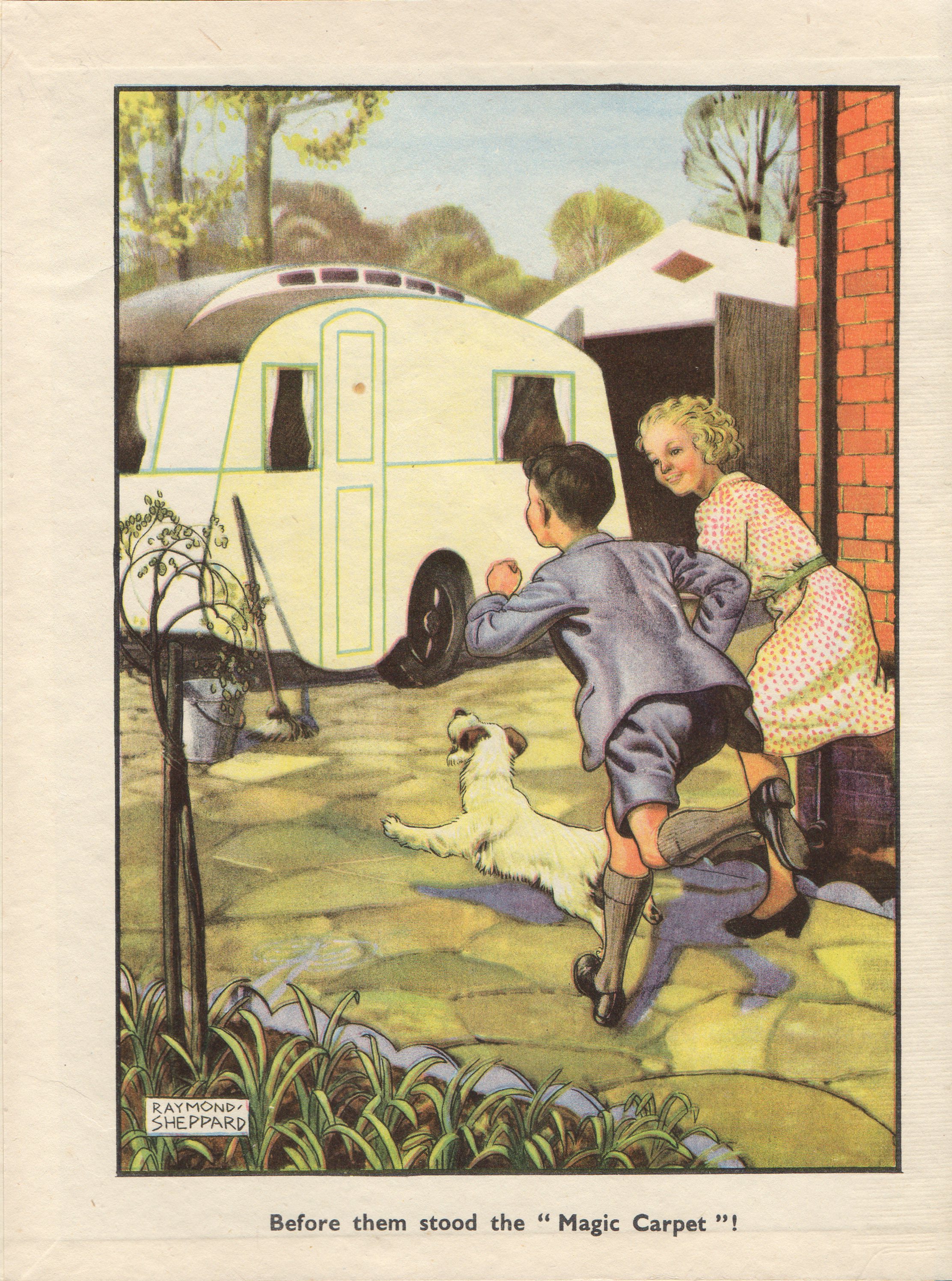
"Before them stood the “magic carpet”"
The children rush to see the caravan

Title page - with inscription!
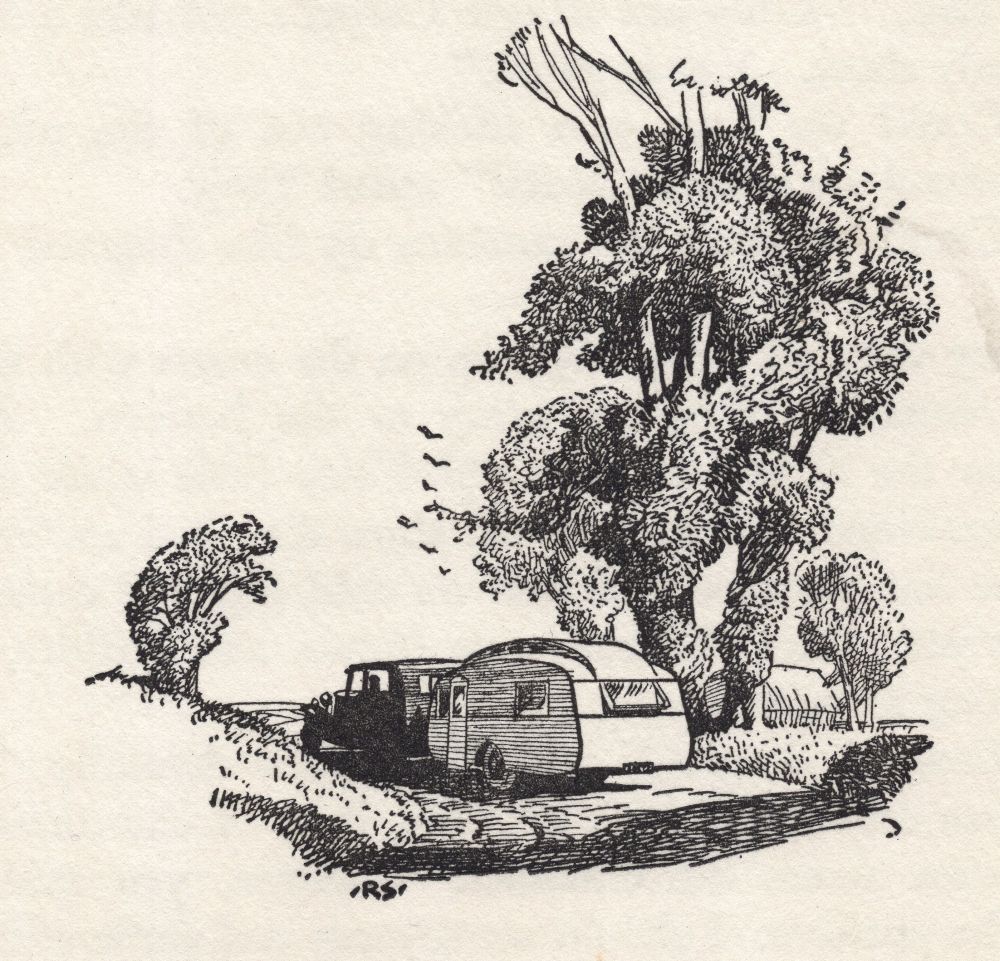
The car towing the caravan

"The swallows came back"

"'There are houses across those fields', said Tony"
The children (and Colin) spot a church and village

"Buying Mother's birthday present"
A lovely scene of an old-fashioned corner shop

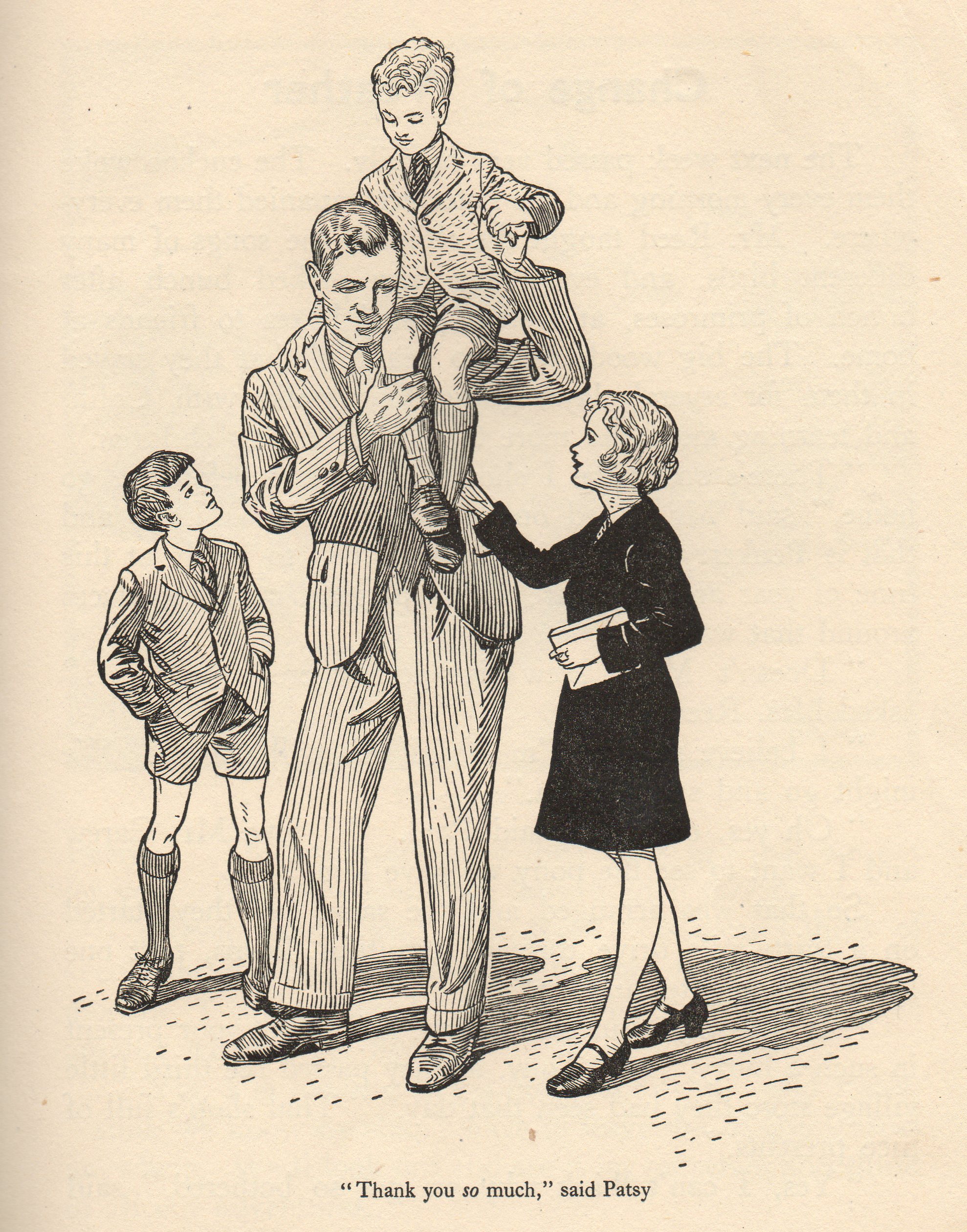
“Thank you so much”, said Patsy
George lifts Paul up on his shoulder
"Thanks so much" is unusual in this series, being a black and white full page where the only full pages are normally in colour
"The drive to the Beacon"

The family run through the snowstorm

"A spring snow-storm"
The snow starts falling

"It's getting like a blizzard"
Father and the boys watch from inside the caravan

The family walk in the snow - Original Art

"Breakfast on the road"
The family walk in the snow - as published
The colours of the original art still look bright and compare them to the published version.
"Tony gets busy"
Tony shovels snow from the caravan door

"Here he comes, late for breakfast as usual"

"Peacocks"

 "The best-tempered of ponies"
Harry rides the pony

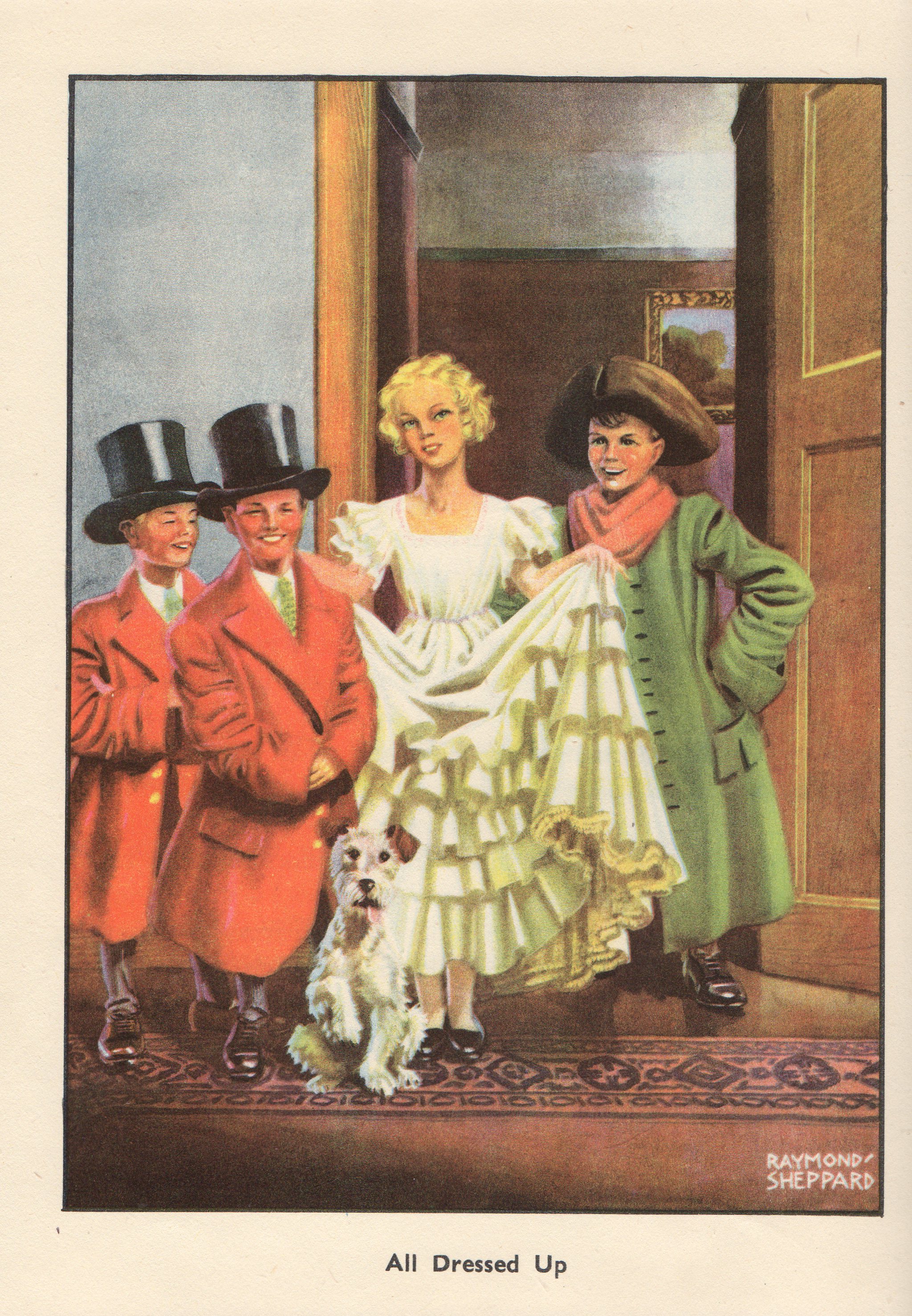
"All dressed up"
The children put on a play, all dressed up

"Where could those children be?"
The men search the secret passage for the children

Picking daffoldils

"Homeward Bound"

Notice the two rabbits on the verge after the caravan has driven past - a nice image for the endpaper of this book.

I did wonder putting this together whether the books were each designed to map the seasons as Our House on Wheels is set in Summer, Our Camping Holiday is set in Autumn, and the last Our Caravan is set in Winter/Spring. The theme was popular as we have seen with Maribel Edwin's titles for example.

Monday, 10 April 2023

Raymond Sheppard and Our Camping Holiday


Our Camping Holiday cover

 In previous articles I've shown the compilation The Caravan Family and also Our House on Wheels. This time it's the turn of Our Camping Holiday.

 The stories featured are:

  • An Autumn Outing
  • A Friend On The Road
  • An Adventure And A Surprise
  • All Together
  • The Caravan Dragon
  • "Deer!"
  • The Pony Fair
  • All The Fun!
  • Rain!
  • The Flood

Because some of the reproductions in my copy are rather washed out - especially with the colour prints, I have decided to scan the ones from The Caravan Family. I'd love to know if others see the same thing in their copy of this book. I've repeated the original art for the fairground ride below to show some difference between the original and the printed version. The colour of image of Colin the terrier (below) was used on the cover of Animals: Stories and pictures (which was also published by Blackie) which I've yet to show on this blog. Quite a few images are used for the 'Caravan' series in fact.

"An Autumn picnic" Inside cover

Title page
"Patsy rushed in"
Patsy tells the boys (and Colin) the good news

"Tony explores"
Tony is followed by Colin the dog climbing the church tower

"On the road in Autumn"
The car and caravan travel towards a church

"The wrong caravan!"
Tony jumps into the wrong caravan!

"Colin"
The Terrier stands and begs with a bone nearby

The image used on the title page
of the car and caravan

"Patsy wins a prize"
Patsy (and Colin) collect the 5 shillings prize

"The prize monster"
Car and caravan are dressed up as a dragon for the carnival

"The red deer won't wait"
Four deer leaping a bush

The three children attend a pony fair

"The fun of the fair"
The children on the fairground swing-boats

"A pony bargain!"
A present for Mr. Carew

"Full speed around!"
The Merry-go-round

Original art

The family park under chestnut trees in a farmer's field!"
Mum

“Here's a pretty mess!”!"
The family wake to a flood around the car and caravan

"Rescued from the flood"!"
The children are rescued on horses


Other titles in the series:

The Caravan Family containing: