Monday, 2 May 2022

Raymond Sheppard and Geoffrey Pollard


Lilliput March-April 1951 p.65 (Original Art)

The search for a biography of an author can be fascinating in itself. I hate writing information I'm not sure of and Geoffrey Alan Pollard, whose work in Lilliput Sheppard illustrated four times, set me a merry chase.

Lilliput March-April 1951 p.5
So we'll start with this small biography in the same issue as the illustration above. This tells me he was born c. 1926-1927 and is a barrister.
Lilliput March-April 1951 p.65

Lilliput March-April 1951 p.66-67

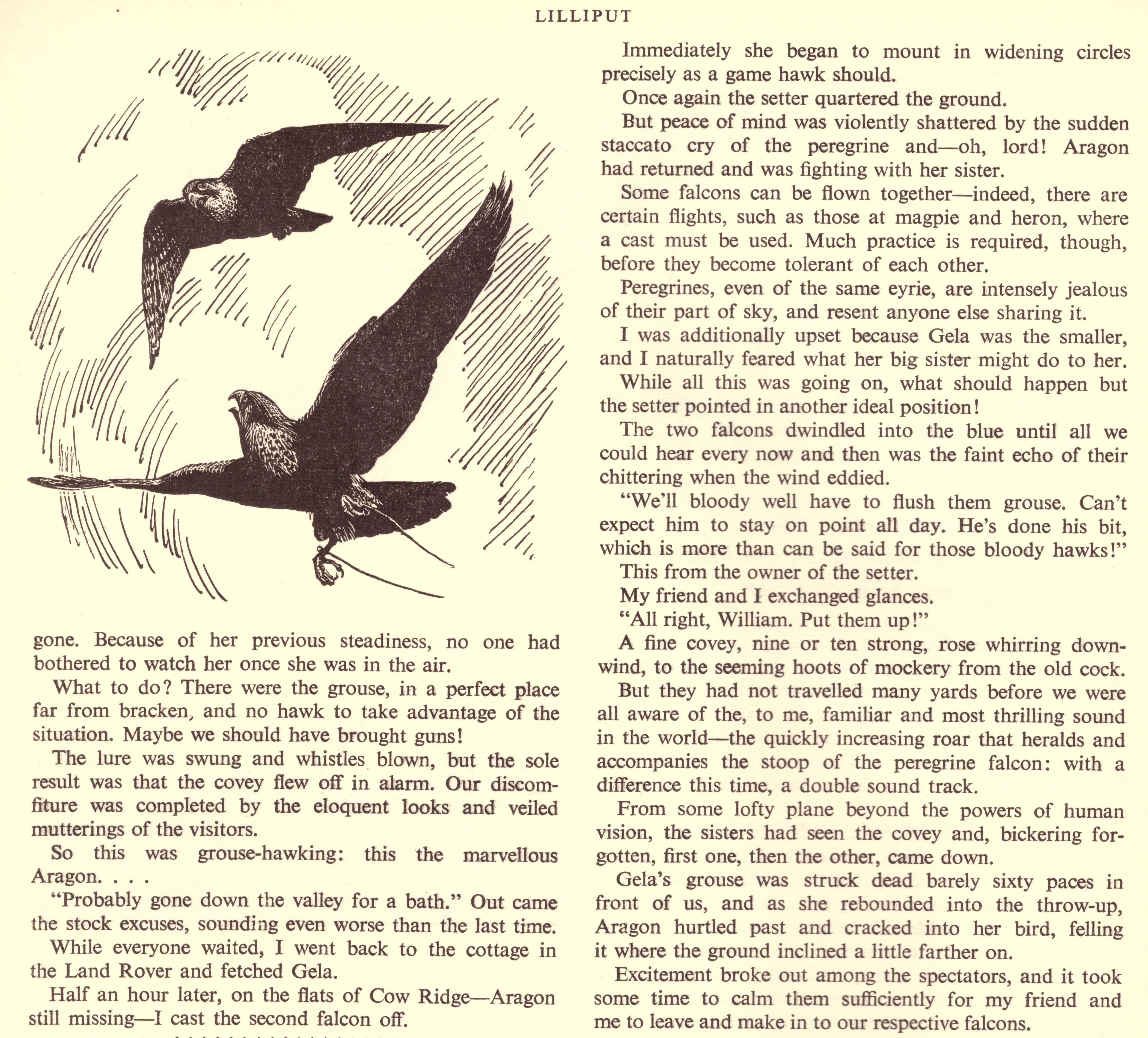
The above article from Lilliput (March-April 1951), "The ringing flight" by Geoffrey Pollard appeared over three pages - and I show the full article here as a thank you to any falconers who visit, as they helped me in my search for our Geoffrey Pollard.

Lilliput Aug-Sep 1952 p.72

Lilliput Aug-Sep 1952 p.73

Lilliput Aug-Sep 1952 p.74a

Lilliput Aug-Sep 1952 p.74b

The above article, a year later (Lilliput Aug-Sep 1952) "First blood" shows  a peregrine on post with second peregrine in the background; a peregrine taking off; a peregrine chasing a grouse on a golf course and finally a peregrine hitting a mallard in flight

Lilliput Sep- Oct 1953 p.52

Lilliput Sep- Oct 1953 p.53a

Lilliput Sep- Oct 1953 p.53b

Lilliput Sep- Oct 1953 p.54

In Lilliput Sep-Oct, 1953, we get "Winged shotgun". Pollard writes of his experiences of "long-wings", such as peregrines and focuses here on "short-wings" such as goshawks. Sheppard illustrates a goshawk attacking partridge; a flying partridge; what looks to me to be Pollard himself with a goshawk and finally a goshawk catching a rabbit.

Lilliput January 1957 p.28

Lilliput January 1957 p.29

Lilliput changed from the pocket-sized magazine it was famous for, to a larger size more in-keeping with other magazines in January 1954. Pollard's last piece for Lilliput was  "Right and left" which appeared in January 1957 and told the tale of two eyasses which apparently  are "hawks which has been brought up from the nest, as distinguished from a hawk caught and trained". The two illustrations reflect Pollard's story where, when the two falcons are on the moor, a crowd might gather and secondly one bird which was lost, suddenly appears aggressively, protecting its part of the sky from its sister!

Christine Sheppard kindly let me photograph the original artwork for this story - crudely I have to confess, but that's my fault, but I still think worth showing
Note the Art Editor's annotations!

I found this article in an Australian newspaper:

THESE FALCONS GO TO WAR
Geoffrey Pollard is a barrister who has been interested in falconry for many years. In a BBC talk he spoke about this mediaeval pastime which, although long extinct as a sport, still exists amongst a small body of enthusiasts which has kept and trained hawks for hundreds of years. In nearly every war. including the last one, both sides have used trained falcons to Intercept enemy carrier pigeons. In 1947 and 1948 peregrine falcons were used on some United Kingdom aerodromes to clear them of birds before aircraft took off and landed. Seagulls were the worst offenders in standing about on the airfields and as peregrines would not chase them it was decided to get gyrfalcons from Iceland. Gyrfalcons are the largest, fastest and most powerful of all the falcon family.
FOUR FEET WINGS
"They are also the rarest," said Pollard, "Gyrs breed on and above the Arctic Circle and no bird that flies, not even the wild swan is safe from them. They have a wing span of rather more than four feet and the female, called the falcon as opposed to the male or "tiercel", which is smaller, weighs over four pounds. They can drive eagles with the ease of a collie driving sheep." From: Narromine News and Trangie Advocate (NSW), 3 February 1953, page 9 c/o Trove
Pollard, as it says above, gave a 15 minute talk on the BBC Home Service entitled "Gyrfalcons" on 26th September 1952, at 19:45. The Radio Times states 

Talk by Geoffrey Pollard
The speaker, one of the small band of falconers in this country, describes an expedition to northern Norway in search of young birds.

In 1939 Pollard is listed (with his birthday as 28 October 1926) as "at school" and residing at Chesterton, Melville Road, Falmouth, Cornwall.I presume it's his son who wrote this short piece for Blundell's School's website (accessed from the Old Blundellians). Pollard passed away on 15 October 2006 (in Rickmansworth) and was a pupil at the Devon school between 1941-1943

Geoffrey had a life-long interest in falconry and was one of the leading British falconers.  He set records for his bags of Red Grouse which he killed in the 60’s in Caithness with his team of Peregrines.
He was a successful criminal defence lawyer and was a frequent participant at Uxbridge Magistrates Court due to the close proximity to Heathrow and his office in Hayes, Middlesex.  In the 70’s he represented many drug traffickers and at least one hijacker!  When he passed away, Geoffrey was 11 days short of his 80th birthday.

Nick Pollard

There's a lovely tribute that also confirms the data above on the Peregrine Fund website where there's also a plaque dedicated to Pollard. It's easier to visit virtually as the memorial is in Idaho of all places! 

In conclusion... Raymond Sheppard was the perfect choice to draw illustrations for Pollard's works. I can't find any record of any authored books by Pollard but must mention one more article (for the completists) which appeared in Lilliput  July 1954 "The Passage Hawk on pp. 68-70 with an illustration by Oliver Heywood, thus not shown here.

The Passage Hawk, (ar) Lilliput July 1954

Saturday, 2 April 2022

Raymond Sheppard and Boy's Own Paper and Keith Horan

Boy's Own Paper May 1956, pp.26-27

Back in 2012, I showed the colour cover and inside illustration from Boy's Own Paper of May 1955. The story "The Red Fear" by Keith Horan was about how tigers and even elephants stand aside when packs of red dogs roam on the Deccan Plateau of southern India. 

Today I want to concentrate on the other three stories written by Keith Horan and illustrated by Sheppard. 

The April 1957 issue of Boy's Own Paper has "Terror of the Air"; May 1956 we have "The Masked Terror", January 1958 the story "Guardian of the Water-Gate" and in the issue dated June 1958 we sadly have not only Sheppard's last work for Boy's Own Paper but also a tribute to him in the story "The Monarch of Silver Pool".  

The first "The Masked Terror" (see above illustration) has some superb writing, engaging the reader with horror, whilst teaching subversively about nature:

Nearly two inches in length, it had a long, pointed body, ringed and armoured and ending in a sort of spike. lts thorax was also armoured and from it protruded six legs.  The back of its head consisted mostly of two black, staring globes of eyes, and the front, where its face and mouth should have been, was covered by a smooth, featureless mask split down the middle and reaching down to its breast. This mask, a combination of the Inquisition and the Klu-KIux-Klan, gave the monster a ghastly look of blank, mysterious horror.
Such terrors are Horan's description of the hunting skills and the insatiable hunger of the dragonfly larva!

Boy's Own Paper April 1957, p.26

The second is called "Terror of the air" and again is a tale of a dragonfly, but this time in the Himalayas. Again a voracious eater who eats things larger than itself!

Boy's Own Paper January 1958, p.18

"Guardian of the Water-gate" (January 1958)  is about a family of muskrat and the attack by a mink, who apparently cannot hold their breath as long as a muskrat. In the final battle depicted above, the muskrat father kills the attacking mink. Again the writing is tense, descriptive without being gruesome. 

Boy's Own Paper June 1958, p.18-19

Lastly we have "The Monarch of the Silver Pool" - who is a twenty inch long trout. We follow his adventures as a fingerling being caught by a fisherman who wisely puts the little trout back. we then read about a boy tickling the trout until a Bailiff comes along. Finally, grown up and as a 'monarch', an otter comes along with four webbed feet and a strong tail and an agility that finally leads to the Monarch's demise. 

On Monday the 21 April 1958, Raymond Sheppard passed away. Jack Cox, the Editor of Boy's Own Paper at the time, wrote the above tribute (with a few minor questionable facts).  Nevertheless it looks as if he must have known Sheppard, for this is quite affectionate and the only tribute I have so far seen in the magazine.

Getting back to Horan, he has two stories in Young Elizabethan that I know of ("Anek's Tapek "mentioned here) which are illustrated by Sheppard and after extensive searching in bibliographies and on the net, I have drawn a blank beyond this. There are various Horans in genealogical databases and the Times has a note of the engagement and wedding of "Pamela Horan only daughter of Lieutenant-Colonel Horan, late 43rd Light Infantry (Oxford & Buckinghamshire) and Mrs Guy Rickard of Liphook, Hants."  BUT I don't know if this is him.

If anyone knows more about Horan (what this a pseudonym?) and any details of his life - and why he wrote no books under that name! - please do get in touch.

BIBLIOGRAPHY

     Horan, Keith (fl. 1940s-1950s)

        * Men, Meal, and Memories, (ar) Blackwood’s Magazine May 1951, as by “Won-Tolla”
        * Fun and Game, (ss) Blackwood’s Magazine September 1951, as by “Won-Tolla”
        * Pictures in the Fire, (ss) Blackwood’s Magazine November 1951, as by “Won-Tolla”
        * The Letter, (ss) Britannia and Eve December 1951
        * Escape, (ss) Argosy (UK) April 1952
        * Stand By—Maternity Case!, (ss) John Bull December 5 1953
        * Kubosko, (ss) The Boy’s Own Paper June 1954
        *[Resurgam, The World's News, 20 Nov 1954]?
        * The Red Fear, (ss) The Boy’s Own Paper May 1955
        * My Friend Bunda, (ss) The Boy’s Own Paper August 1955
        * Death in the grass, The Boy's Own Paper, September 1955
        * The Masked Terror, (ss) The Boy’s Own Paper May 1956
        * Terror of the Air, (ss) The Boy’s Own Paper April 1957
        * Anek's Tapek by Keith Horan Young Elizabethan June 1957
        * Forests of the night, Young Elizabethan, January 1958
        * Guardian of the water-gate, The Boy’s Own Paper, January 1958
        * The Monarch of Silver Pool, The Boy’s Own Paper, June 1958
        * White Fury, (ss) The Boy’s Own Paper February 1961

Thanks to the invaluable FictionMags Index and my own added research

Other than this, he remains a very big mystery which is a shame as I really enjoyed reading his short stories of nature "in tooth and claw"!

Tuesday, 1 March 2022

Raymond Sheppard and Round the Year Stories: Autumn

Round the Year Stories: Autumn - cover

We have covered Spring and Summer and today we look at Autumn! The first article included a biography but a very thin one. So let's rectify that here:

Maribel Thomson was born 23 April 1895, in Aberdeen and she was indeed the daughter of Sir John Arthur Thomson and Lady Margaret R Thomson. She married Charles Frank Edwin, 11 years her senior, (born 27 February 1884?) and they settled in Surrey after marrying in St. John the Evangelist, Blackheath in the summer of 1921 (when she was 26 years old). Charles' father was also Charles Frank born in Worcester. Charles (junior) was born in Guildford Surrey and his speciality later in life was electrical engineering - not surprising he was practical, as his father was a watchmaker. They were living at "Sunrays", Milton Avenue, Westcott, Dorking in 1952 according to the Electoral Register, - there was auction of contents of that house in 1950 so perhaps we have a date range for the move there. I suspect Maribel died at the Garth Nursing Home, Tower Hill Road, Dorking, Surrey, on 25 September 1985 which would make her 90 years old. If I've got the right Maribel, probate was £139,077.

Anyway let's look at Raymond Sheppard's images drawn for this book.

Round the Year: Autumn, p.15
"Down came the dagger-bill in a flash" 
Heron attacking underbelly of a rat

Round the Year: Autumn, p.23
"He landed on the one spot that was rather like home to him"
Skylark on ground

Round the Year: Autumn, p.29
"Over and over rolled the two little animals"
Two shrews fighting

Round the Year: Autumn, p.37
"There was a terrific clash and rattle as the two pairs of antlers meet" 
Two stags do battle

Round the Year: Autumn, p.41
"The leader of the herd"  - A stag bellows

Round the Year: Autumn, p.45
"They flew swiftly and steadily away towards Africa"
Swallows flying

Round the Year: Autumn, p.51
"Lintie began to beat himself against the netting"
A linnet on wire mesh

Round the Year: Autumn, p.59
"Down shot Seep, followed closely by his enemy"
A redwing pinned down by a hawk

Round the Year: Autumn, p.65
"There was no fear of starving in this place" 
An otter climbs on bank with fish

Round the Year: Autumn, p.67
"Gyppo followed the trout wherever it went" 
Otter chasing trout

Round the Year: Autumn, p.75
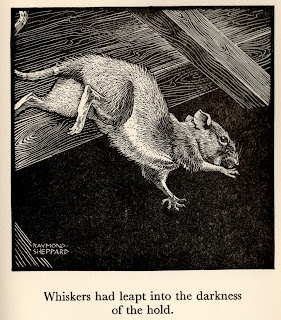
"Whiskers had leapt into the darkness of the hold"
A brown rat leaping

Round the Year: Autumn, p.81
"He all but collided with a swallow" 
A swallow crashes into a wren

Round the Year: Autumn, p.89
"Buff twisted the tip of his tail round a twig"
A dormouse climbing foliage

Round the Year: Autumn, p.95
"Away went Bunny as fast as his legs would carry him" 
A rabbit flees from a stoat

Round the Year: Autumn, p.97
"Black-Tip sprang at the crow- and he hung on"
A stoat grabs a crow in flight while a rabbit watches

Round the Year: Autumn, p.103
"Tawny was at once set upon by a mob of indignant starlings, tits and sparrows"
Starling, tit and sparrow attack a tawny owl

Round the Year: Autumn, Frontispiece
"Franky pushed himself off and flapped slowly away"
Grey heron takes flight


 In an earlier article on this series, I showed some proof printings and how they differed so much from what was printed. Today I can show you the Frontispiece illustration above, so you can compare them. This was  for sale a while ago and I captured the image from the auctioneer's site.

The grey heron flying

Here's a link to all four Edwin versions:


Wednesday, 2 February 2022

Raymond Sheppard and Way for a Sailor

Way for a Sailor - Cover by Raymond Sheppard
 Peter Dawlish, the pseudonym of James Lennox Kerr (1 July 1899 – 11 March 1963), was a Scottish socialist author whose fame rested on his sea stories for young boys. He also used the pseudonym Gavin Douglas for his adult works with his last work found being published close to his death. Some of the "Dauntless" series were reprinted by publisher John Goodchild (of Wendover) in the Eighties with new titles..

It appears Dr. Stephen Bigger is the champion of Kerr's stories as he has blogged about the writer and also started the Wikipedia page. If you search the afore-mentioned blog for Lennox Kerr or Dawlish you'll see many entries. You can also access his e-print (PDF) of 8 pages on University of Worcester's site including two photos of the author and a bibliography.

Way for a sailor - Frontispiece
showing the harbour where Ronald starts his new life

I'm concentrating, of course on Raymond Sheppard whose sole work for 'Dawlish' was Way for a Sailor.  The blurb on the dustjacket reads:

Young Ronald McKay ran and fought and shouted as a small boy in the back streets of a Scottish industrial town—a natural leader, who on the strength of one highly coloured sea story, picked up by chance, becomes obsessed with a passion for the sea that he has never seen, and ships that he has only dreamt about. Way for a Sailor is a story of determination. It closes with Ronald about to go to sea as a ship's boy, for a summer holiday apprenticeship on a Scottish coast¬ing vessel; and by the time that we reach the last page, we have shared the boy's passionate longing for the sea, his stratagems to earn enough money to buy a share in a leaky old rowing boat, his conflict with his father and mother, and the whole bewildering, exciting business of growing up with one overriding ambition—to be a sailor.
Peter Dawlish has a distinguished name among writers of sea stories for boys, and much of his own boyhood has gone into Way for a Sailor. There is an urgency and conviction in this latest book, which carries the reader with it : it will command the interest of any boy who has ever thought of going to sea.
For other books by Peter Dawlish see back flap and back of jacket
Ages 12 and up Price (in U.K. only) 9s 6d net

Christine Sheppard still has the two bromides - proof copies of the illustrations from this book. My photos of them are crude and show them out of order compared to the published version:


I love the image of the frontispiece above showing the steep decline to the harbour. I'd love to know if it's a real place. I thought Robin Hood's Bay in Yorkshire a steep drop, but this image gives me vertigo! Note also the many details Sheppard has drawn - to the hree seagulls on the roof. I have to say the row-boat in the harbour looks to be wrong in size to me.

Way for a sailor - p.1
Ronald & friends enact battles

Way for a sailor - p.21
Ronald visits a terrifying place - the Library!

Way for a sailor - p.39
Ronald meets Mr Paterson - and his boat for £1!

Way for a sailor - p. 57
Ronald works hard to earn the £1

Way for a sailor - p. 87
Ronald, his dad and Mr Paterson meet

Way for a sailor - p. 105
Ronald & Mr. Paterson go out to collect flotsam

Way for a sailor - p.118
Ronald shows where everyone must sit in his boat

Way for a sailor - p.139
Ronald runs away from the town to sea

Way for a sailor - p.146
Ronald hides and gets a lift to the coast

Way for a sailor - p.168
Ronald makes new friends on board the schooner

Way for a sailor - p.186
A dare goes wrong for Ronald

Way for a sailor - p.201
Ronald's new 'friend' hides him in the dirty hold

I found a review of the book - children's books had few places to be reviewed! - in the Boy's Own Paper of February 1956 (p.31) which gives a good account of the story, including the beginning which soon gets forgotten as we follow the child version of the Commodore!

Boy's Own Paper Feb 196, p.31