Monday, 24 October 2022

Raymond Sheppard and pigs and racoons

Everybody's magazine (17 March 1956)

I am always looking to my collection to share Raymond Sheppard artwork, but Christine Sheppard has a lot of cuttings and pieces of printed materials which have her Father's artwork on them. How to identify where they appeared? Luck, research, determination and luck is the answer!

For example, let's look at pigs today!

This image of a pig standing upright in a crude wooden pen, with a blank notice attached is unusual. The pig is fully completed but the rest is in outline. I suspect this is an advertising piece, due to the blank notice board on which a product/service name could be printed. Perhaps it appeared in adverts in farming magazines - I haven't found it anywhere else yet.

A pig on hind legs

But interestingly, this looked familiar (see Argosy January 1958) and after consulting my spreadsheet with all sorts of keywords in it, found that I was sort of right.

Everybody's magazine (17 March 1956)

The article which appeared in Everybody's magazine (17 March 1956) was called "If animals went to school" written by R. Quentin Goochley. Such an unusual name you would think was easy to research, but unfortunately, I have found nothing on him! But I did find an almost identical article by a Professor R. W. Goochley in Sydney Morning Herald, (Saturday 31 May 1952, page 6) c/o Trove. Here is the published list of the 10 most intelligent animals:

  1. Chimpanzee.
  2. Capuchin monkey,
  3. Gorilla.
  4. Other monkeys and apes
  5. Dog
  6. Cat.
  7. Elephant
  8. Raccoon
  9. Pig
  10. Horse

An almost identical article was published earlier in the Singapore Straits Times (11 May 1952, page 15). None of the above tells me who this Professor was or why 4 years after this, the article appeared in Everybody's in 1956, this time with Sheppard illustrations.

Here are the other 3 images from the Everybody's article drawn by Raymond Sheppard (the fourth being at the head of this article).

Everybody's magazine (17 March 1956)
The cat and the dog

Everybody's magazine (17 March 1956)
Capuchin monkeys

Everybody's magazine (17 March 1956)
Raccoon

Interestingly, the original art for the raccoon came up for sale in 2016 so I captured the images:

Original coloured artwork

Look and Learn version

The one immediately above has a very visible LOOK AND LEARN stamp. I've consulted Steve Holland who indexed a lot of the artwork on the Look and Learn site but he didn't remember seeing this. As he said  "It's only 1 1/4 inches tall, so it'll be tucked away in a corner somewhere, I guess. Rather smaller than it's original appearance". I suspect that was for the original Everybody's reproduction above. 

[UPDATE: 26 Oct 2022: David Slinn identified the very issue and supplied this scan}

Look & Learn No.25 (7 July 1962)

Look & Learn No.25 (7 July 1962) pp.18-19

How did the art turn up stamped "Look and Learn"? With all the takeovers in 1959-1961 in magazines and comics, it is hard to keep track. We do know that Everybody's was published at this time by Amalgamated Press (and it was merged into John Bull in 1959). But Amalgamated Press was taken over in January 1959 by the Mirror Group (acquiring "42  weeklies, 23 monthlies and 20 annuals") who were based in Fleetway House, Farringdon, leading to a name change to Fleetway Publications in April 1959. In March 1961 when the Mirror group took over Odhams Press they had all 4 major publishing companies: Odhams, Newnes, Hulton and Amalgamated Press. From this body, in January 1962, came Look and Learn with the first issue containing some reprinted Sheppard artwork. Perhaps the stamp is on the artwork because it's an ownership stamp? As an aside Look and Learn have a tremendous picture library - listed on their main page and you'll see they own all the following magazines and comics now: Look and Learn, Treasure, The Bible Story, Ranger, various educational annuals, various nursery comics and annuals plus The Children’s Newspaper.

Anyway I promised a focus on pigs, so here are some shots of original studies and artwork by Raymond Sheppard. Looking at these it's obvious Sheppard could have produced the title for Studio Publications on farm animals, but in 1947, C. F. Tunnicliffe produced the book How to Draw Farm Animals. 

Essex Saddlebacks (24 March 1951)

 
Pig stretching

Piglet sketches

Pig head study

Pig study

Back of pig's head study

Outline front view of pig

Pig lying down & head (signed)

Sow and piglets suckling

Studies of pig' trotters

If you read this far, well done! I thought I'd add another mystery item, I own. This 3 piece wooden jigsaw is not signed but appears to me to be by Raymond Sheppard. I'm happy to be proved wrong.

Jigsaw by Sheppard?


Monday, 26 September 2022

Raymond Sheppard and Woman's Day

Woman's Day 7 June 1958 pp28-29

Firstly I apologise for the quality of the scans provided here. This is a rare item, so photos from bound volumes will have to do till I buy a copy of the magazine!

Christine Sheppard has a cutting pulled from a magazine with no name except the title of the very famous story: "The Snow Goose" by Paul Gallico. I noticed that there was a "motif" stating "A Woman's Day Cameo Book" on the page and set to searching. I then found a cover on eBay which showed that "Woman's Day" was, as suspected the title of the magazine and the cover here shows the idea of the "Cameo Book"

Woman's Day 10 May 1958 showing "Cameo Book"

Yesterday I searched in the British Library through the first volumes and found exactly where the following images were published!  

Woman's Day started publication on 22 March 1958 (and according to the British Library ran till 2 September 1961 = 173 issues). It's size was comparable to other glossies at the time - think Picture Post or Everybodys),  and has some beautiful illustrations by artists like Koolman, Uptton, Edwin Phillips, John Batchelor, Jack M. Faulks, Jack Matthew, and Leslie Caswell. But in a market that was flooded with women's magazines, the horizon was dark, not only with print strikes but amalgamations and takeovers so it's not surprising it merged with Woman's Own

But let's look at Raymond Sheppard's illustrations in the magazine - some of his last.

Woman's Day 30 May 1958

The previous week's magazine to the appearance of "The Snow Goose" trailed the coming event along with the usual content- knitting, fashion, cooking etc.  The idea of the "Cameo Book" was quite flexible, covering film adaptations ("The Song of Bernadette" with stills from the film) but some might have stills plus an illustration commissioned for the event. Others covered were "South Pacific" - yes, the musical, and "An Episode of Sparrows" which is the story adapted as "Innocent Sinners" starring Flora Robson and David Kossoff

Curiously Sheppard's signature appears on the first page of the story (and he is credited) but there are none on the others, including the unusually coloured double page shown at the start of this article.

Woman's Day 7 June 1958 p.25

Woman's Day 7 June 1958 p.27

Woman's Day 7 June 1958 p.30

On the novella's Wikipedia page, we are told: 

The Snow Goose: A Story of Dunkirk is a novella by the American author Paul Gallico. It was first published in 1940 as a short story in The Saturday Evening Post, after which he expanded it to create a short novella which was published on 7 April 1941. 

The Internet Archive has an illustrated (not by Sheppard) copy, if you want to read the book and Sir Laurence Olivier tells the story on YouTube - where other versions can be found to listen to. If you want to know more about the book Martin Benson's page on "The Snow Goose" is interesting

I have mentioned another Gallico story that Sheppard illustrated in one of my first blog articles on Sheppard

As an aside, yesterday after spending the day at the British Library I met some friends. At 7pm the pub rang a very loud ship's bell and announced the very sad news that Her Majesty Queen Elizabeth II has died. One minute of silence followed in the middle of a usually very noisy pub on Euston Road- very strange but very moving. A day that will be remembered for a long time.

Monday, 15 August 2022

Raymond Sheppard and Mountaineering stories (Part Two)


Disaster strikes the first ascent of the Matterhorn, by Gustave Doré

I recently wrote about some mountaineering, hill climbing stories which I saw as a theme in Lilliput stories Raymond Sheppard had illustrated. Continuing this we travel to much higher climes/climbs!

The September 1955 issue of Lilliput shows us the "Disaster on the Matterhorn", written by Ronald Clarke. Interestingly Sheppard re-drew the famous Doré image (at the top of this article).

Lilliput September 1955 p.56
Sheppard after Doré

The title drawing shows the infamous mountain with a cut-in for the title font as can be seen from the original art (courtesy of Christine Sheppard). 

Lilliput September 1955 p.57

The Matterhorn original art by Raymond Sheppard

Clarke gives an overview of the disaster and its aftermath, focussing on Whymper who wrote of the tragic event in 1871 after much pressure to share what happened. Raymond Sheppard produced portraits of the climbers Whymper, Croz, Hadow, Douglas, Taugwalder and Carrel. Interesting one portrait - the latter - was not used.

Lilliput September 1955 p.58: Whymper

Lilliput September 1955 p.59: Croz

Lilliput September 1955 p.60: Hadow

Lilliput September 1955 p.61: Douglas

Lilliput September 1955 p.62: Taugwalder

Here's the original artboard where we can see that the Art Editor has noted "Not this" next to the portrait of Carrel, who was the competing Italian for the summit.

Six portraits - Carrel was unused in the article

Ronald Clarke seems to have specialised in mountaineering articles:

  • Disaster on the Matterhorn, Lilliput September 1955
  • Room for another on Top?, Lilliput February 1956 [This article is about 'Stegophily' - cimbing buildings!]
  • Ironmongery on the Mountains, Lilliput December 1956

I searched for books by the same author and am guessing he might be Ronald William Clarke (not to be confused with the Australian athlete) who wrote:
    

  • Great moments of Rescue. London: Phoenix House, 1959.
  • Sir John Cockcroft. London: Phoenix House, 1959. ('Living Biographies for Young People' series)
  • The rise of the boffins London: Phoenix House, 1962.

Lilliput November 1955 p.15

Lilliput changed in November 1955, with its first photographic cover. In this magazine, "La Haute Route" by Jocelyn Stevens tells the story of two guides, seven men and an 18 year old American girl (the authoress) who, setting off from Zermatt, aim to tour La Haute Route - which was first crossed on skis in 1947. This is the only Sheppard illustration as the rest of the three page article show photos of the group and their map across La Haute Route. 

Thanks to Christine Sheppard we have  part of the original art for the above and also a study for the fallen skier.

Peter, the fallen skier - Original art (part)

Study for Peter, the fallen skier

"Long before they'd reached the summit, the oxygen had run out" is how the next story is introduced. 

Lilliput February 1956 pp56-57

"K2 Conquered!" appeared in Lilliput February 1956, written by Professor Ardito Desio who writes about Compagnoni and Lacedelli's 31 July 1954 attempt on the second highest mountain in the world. I'm not sure if the climbers are looking at the mountain range as we are but the original art for these two pages are naturally one in colour and the other in B&W. 

K2 Conquered - Original art (p.57)

Again I'm indebted to Christine Sheppard for the permission to reproduce these following from original art.  

Lilliput February 1956 p58 - Original Art

The image above shows the mountain range with the camp below with 2 tents in the camp. The next image which appeared on page 59 has the scene of Compagnoni losing his footing and tumbling in the snow.


Lilliput February 1956 p59
This page shows the positioning and choice of sizing for each image. Some could be drawn very detailed but shrunk to a near blot on paper!


Compagnoni losing his footing -Original Art (p.59)

The two masked climbers ascend - Original Art (p.59)

Removing oxygen mask near summit -Original Art (p.60)

Lilliput February 1956 p.61

Dropping into the void - Original art (p.61)

Lacedelli slips on the ice wall - Original Art (p.62)

"A matter of time" by R. M. Martin appeared in Lilliput August 1956. It tells the story of Clive Mander and Peter Halliday climbing Mount Lucifer (which I found out is in Alaska). 

Lilliput August 1956 p. 11

Lilliput August 1956 p. 12

Losing the ice pick - Original Art (partial)

 The climbers are dependent on each other's skills, but accident follows accident. When Halliday falls after hurting his wrist, he is dangling on the rope held by mander, who naturally enough begins to think of how to save at least one of them. A last minute unexp[ected rescue takes place and the two men wonder about what might have been. It's a well-written tale but strangely the author appears to have only written this one story. I can't find anything about him at all.


Friday, 29 July 2022

Raymond Sheppard and John Bull

I have found 5 images illustrated by Raymond Sheppard - so far - which appeared in John Bull. This famous magazine ran from 1906 to the 1960s in one form or another. The excellent Tony Quinn has written more about the magazine and the 1950s issues  are the ones that are very collectable due to their painted covers with idyllic landscapes and sometimes humorous themes.


John Bull 14 June 1952 p.15

The story "Stripey" by Dudley Hoys appeared in John Bull 14 June 1952 and tells a story of salmon spawning, otters being hunted by otter hounds and an unusual site of a stag in 'the western fell'. The image shows a deer being pursued by dogs and the name 'Stripey' comes from the "queer jagged lines on its flanks". 

Dudley Hoys (1899-1980) was born in London, became a Lakeland farmer and died in Henley, Oxfordshire, but was also a prolific author of short stories (the first in 1922; the last c. 1960), appearing, aside from in the UK, to my knowledge, in Canada and Australia. His books include three photographic and illustrated titles on the Lake District, he wrote a comedy for the BBC in 1949. I also found reference to a bench dedicated to Captain Hoys at St. Catherine's Church, Eskdale, Holmrook, and he appears to have been a member of the Cumbrian Literary Group from which he retired in 1956/1957.  I couldn't find any photos which is a shame.

DUDLEY HOYS BOOKS BIBLIOGRAPHY

Ecstasy. [A novel.]. London: Jarrolds, 1930.
Quiet Men. London: Jarrolds, [1930]
The Persian Peril. London : Gramol Publications, [1936]
They Found a Handkerchief. London: Oxford University Press, 1940.
Below Scafell. London: Oxford University Press; drawings by Lynton Lamb, 1955.
English Lakeland in Colour: A collection of colour photographs. With an introductory text and notes on the illustrations by D. Hoys. London: B.T. Batsford, 1959.
English lake country. London: Batsford, 1969.
Old Will stories. New York, N.Y.: Privately printed at the Press of Francis Emory Fitch; drawings by J. Brian Crossland, 1971
More Old Will Stories. New York, N.Y.: Francis Emory Fitch, 1971

An extensive listing of his short story fiction can be found on The FictionMags Index.
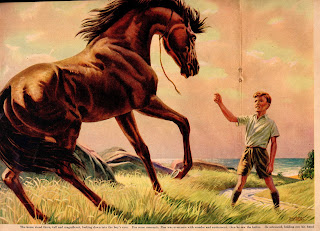
 

John Bull 11 October 1952 pp20-21

The next published was "The Wild Horse" by Nina Beachcroft, (11 October 1952, pp20-21). The caption reads: "The horse stood there tall and magnificent looking down into the boy's eyes. For some moments Ron was overcome with wonder and excitement. Then he saw the halter. He advanced holding out his hand"

John Bull 11 October 1952 p22

 "His voice was urgent, pleading. “I want to go and look for the horse Mum. Let me – please”    Horse rearing back from boy whose arm is extended towards it / (Page 22) Ron pleads with his mother to look for the missing horse.

Ellinor Nina Beachcroft was born in Kensington in 10 November 1931. Her father was an author  and Nina became known for children's fantasy after "Well Met by Witchlight" was published in 1972.

NINA BEACHCROFT BOOKS BIBLIOGRAPHY

Well Met by Witchlight. London: Heinemann, 1972.
Under the Enchanter. London: Heinemann, 1974.
Cold Christmas: a ghost story. London: Heinemann, 1974.
A Spell of Sleep. London: Heinemann, 1976.
A Visit to Folly Castle. London: Heinemann, 1977.
A Farthing for the Fair. London: Heinemann, ; illustrated by Anthony Colbert, 1978.
The Wishing People. London: Heinemann, 1980.
The Genie and her Bottle. London: Heinemann, 1983.
Beyond World's End. London: Heinemann, 1985.

The only short story I could find is the John Bull one above! To read an overview of Beachcroft's children's books from September 1985 see Books for Keeps. Her daughter Helen Osborn (née Gardner, 5 July 1961- ) has been an archivist and is a genealogist. She was born in Datchworth Green, near Knebworth, Hertfordshire and her sister is anthropologist and fiction author Katy Gardner.

John Bull 13 December 1952 p.7

The next illustration accompanies a story ("King Lion") by one Alastair Scobie. The caption reads: "He got to his feet, and. like a grave, middle-aged man, disturbed in his nap, stood there blinking. Then with a growl he slowly turned his head". You'll notice there are two men with a double barrelled shotgun lying in grass watching the lion.

 Alastair Scobie appears to have been born in 1918 and the excellent FictionMags Index lists only two works of fiction (included below) but interestingly has a link to his work - as a film write and director!  This is confirmed by Shakari Connection which shows the covers of his books.

ALASTAIR SCOBIE BIBLIOGRAPHY

So She Sent Flowers. London: Shakespeare Head, 1946
Kangaroo Shoots Man. London: Cassell, 1949.
Murder à la Mozambique. London: Cassell & Co, 1950.
The Cape Town Affair. London: Cassell & Co, 1952.
Animal Heaven. London: Cassell & Co, 1953.
Adventurer's Paradise. London: Cassell & Co, 1955.
Men against the Sun. London: Cassell, 1959.
Women of Africa. London: Cassell, 1960.
Murder for Magic: Witchcraft in Africa. London: Cassell, 1965.

Short stories:

"Maneater", Argosy (UK) January 1953
"The Natives Are Hostile", Lilliput March 1955

"One faded star" Britannia and Eve 1 February 1950

[Unknown] John Bull 5 April 1958

"The strangest hotel in the world". Eagle Vol1:39, 29 December 1950

 All entries I've found list works based on African themes - photography and hunting, so this could be the same man who is a Director/Screenplay author.

John Bull 18 April 1953 p14

The last image by Raymond Sheppard that I have found, in John Bull is accompanying "The horse with the roving eye" by Dal Stivens. I've talked about Dal Stivens before on this blog, so that's the end of this article.

If you want to learn more about British magazines I'd recommend Tony's site MagForum - here's more on John Bull and its successor Today.