Monday, 20 June 2022

Raymond Sheppard and Mountaineering stories (Part One)


The theme of mountaineering and skiing appeared in many weekly magazines all over the world. I suspect Lilliput picked the stories up as a result of the renewed interest due to the summit of Mount Everest finally being reached on 29 May 1953 by Sir Edmund Hillary and Tenzing Norgay.  But not all stories need such a dramatic backdrop to inspire fiction and inspire superb drawings by Raymond Sheppard. I've selected the ones which relate stories of climbing in some form or other.

Lilliput June-July 1952 p.67

Lilliput June - July 1952 issue has a story by A. Crossland called "Too much rope".  It concerns a man called Wessex and another, Runnymede, who he is guiding up the Gable in the Lake District. Sheppard shows a man in a beret stretching across a cliff face and trying to loop a rope through 'the needle'. You can read a bit about these climbs here. A second smaller illustrations shows the two men triumphantly sitting enjoying a sandwich. 

Lilliput June-July 1952 p.69

 I couldn't find anything about the author and his three pages of text do not lead me to think he would be employed again as I felt they didn't portray what should have been an exciting adventure, but maybe this is a nom-de-plume!

Lilliput April-May 1953 p.61

The second article "Avalanche" appeared in the April-May 1953 issue of Lilliput. It was written by Gibson Cowan, who we have met before on this blog (with a hyphen!) and who we shall meet again as he was quite prolific in Lilliput. This tale of a skier with two Germans relates in first person the journey which leads to a fall. We are fortunate in having access to the original art (thanks to Christine Sheppard), in which we can see registration marks applied to aid photographing the original for publication.


"Avalanche" original art

One reviewer on a climbing website called "Slieve Beg Mountain" (or Sliabh Beag in Irish, meaning  'little mountain') "a little mountain with a big attitude". The mountain in question is in the Mourne Mountains of County Down, Northern Ireland. Its height is 595.9 metres as is the subject of the third article I want to show you. 

Lilliput May-June 1953 p.40

"Slieve Beg Buttress" by Frank Ritchie tells how two climbers (Ted Stewart and Billy Morrison)  master the mountain - one experienced; the other learning. Over six pages of text (and accompanied by Sheppard's illustrations), we certainly get a sense of the tension and muscle ache and depression from slipping and having to carry on. A real nail-biter of a tale which ends in triumph. It looks as if Ritchie, the author, didn't write anything else for Lilliput and indeed I can't find any information on him beyond this tale.

Lilliput May-June 1953 p.43

Lilliput May-June 1953 p.44

Lilliput May-June 1953 p.45

Lilliput May-June 1953 p.46

The last story I want to share today is about "The Swaledale Ram".


Lilliput June 1955, pp40-41

Dudley Hoys is the author of this tale from Lilliput June 1955 and I recently mentioned his story in John Bull which was also illustrated by Sheppard. The dramatic opening shot of a man on top of a cliff watching as another man on a rope falling, begins the tale of two farmers who start as feuding neighbours but soon help each other rescue not only the ram on the ledge!


"The Swaledale Ram" original art - cropped

The two other images Raymond Sheppard drew appeared on pages 41 (see above image) and 42 and show the ram on the ledge and the final struggle to get the ram over the top of the rockface. 

The Swaledale ram on the ledge! Original art

 
Lilliput June 1955, pp42

The final tug - original art

Lastly we also have, thanks to Christine, a study her father did which I think is of the farmer dropping off the cliff face above, although there are slight variations - the hand of the right open / closed.

Study for "The Swaledale Ram"?


Part Two to follow, including K2, and the Matterhorn.

Monday, 6 June 2022

Raymond Sheppard and Who goes over the sea

Who goes over the sea Cover

"Who goes to the wood, goes to his mother"

When I share Sheppard's illustrations I track down some details on authors I've not heard of. Sometimes there's lots of information; other times hardly anything. In this case we have quite a bit. But first those illustrations beginning with the cover, which is repeated in colour as a frontispiece. "They joined themselves to that happy company going over Sea" says the caption there. And this is the first time we encounter the lack of the definite article in Inchfawn's writing (but not in the title). All parts of nature become proper nouns, as seen in the blurb below.

Who goes over the sea? The answer is the birds who come from abroad to spend their summer here, and in this delightful book Fay Inchfawn tells of the life on a farm where these birds live for a season. All children will love this story for it is written in the charming style well known to readers of Who Goes to the Wood and Who Goes to the Garden

Winter had been cold, but as spring approached Wood put on its summer dress, Rain and Storm departed, and there came the Day Which Was Different—the day of the arrival of the first birds from abroad: chiff-chaffs and blackcaps, white-throats and willow-wrens, and cuckoo. Nests were quickly made, eggs laid and hatched, young fed and taught to fly.
It was a happy summer (even though House-keeper left the farm in a huff and had strange adventures involving a peacock and a bantam cock), for when the birds and animals had any Problems they were soon solved by Weatherfox on the roof, and it was he who sent Whiskers, the tabby cat, in search of Housekeeper. It was a wonderful adventure for Whiskers, but small compared to the one that faced the birds as summer drew to its close, for soon after Housekeeper's welcome return (and she was glad to be back) they and their young set out on the long journey to a warmer land, to a land over the sea.

"Who goes to the wood, goes to his mother" is apparently an old saying, but I can't find any reference to it and frankly don't know what it means. Perhaps it's a local Cornish expression?  Inchfawn states, this is where she got the idea from for one of the three books in her "Who goes..." series which included "Who goes to the Wood", "Who goes to the Garden"  and this title "Who goes over the sea". The latter is the only one in which Raymond Sheppard does the  illustrations.

Who goes over the sea p.9

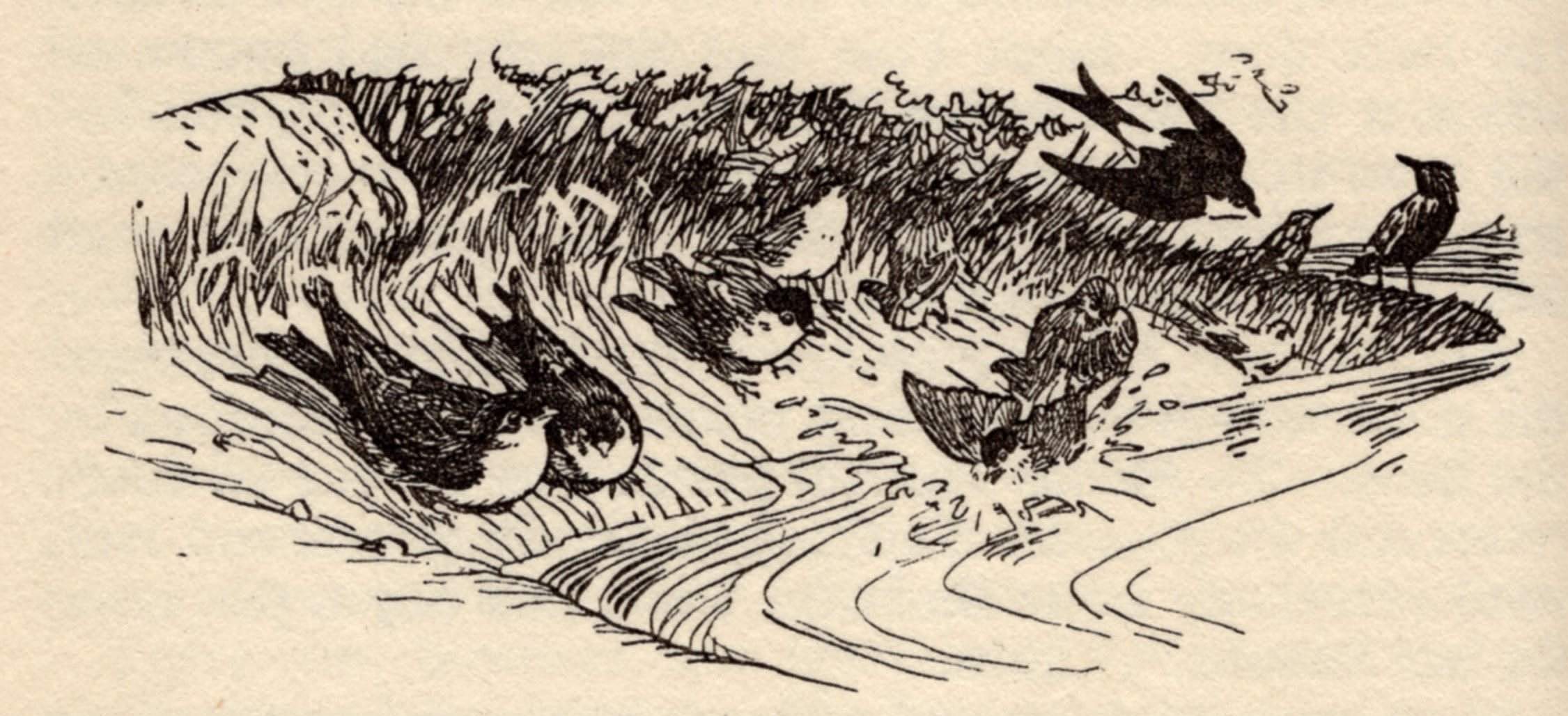
There's a wonderful observant line to accompany the picture of Black Puss and Magpie: "As Magpie danced, he wound up his clock and chanted"  - just like a magpie's cry!

Who goes over the sea p.13

Farmer and Ploughman feed Whiskers in the above image. And below the chiff-chaffs tell River "No Fuss! No Fuss!" as they bathe and drink.

Who goes over the sea p.34

Sometimes Sheppard creates an image I don't want to play with as text wraps around it and a fight between Hedge-Sparrow and House Sparrow is such an image. .

Who goes over the sea p.39

In the next image, of Rover enjoying his bone, we see a rare signature, where Raymond Sheppard draws an 'R' intersected by a long 'S', similar

Who goes over the sea p.64

Who goes over the sea p.68
'Housekeeper' with 'Bantam' heading down towards the harbour
and 'Wind' from the sea nearly blowing her off her feet!

Who goes over the sea p.76
'Shuffle-Wing' and the other warblers in 'Weeping Ash'.

Who goes over the sea p.94
"Wait for me!" screamed Peacock to Housekeeper

Who goes over the sea p.111
"Whiskers sat down and began to purr"

Who goes over the sea p.123
"The travellers entered Beautiful Wood"

Who goes over the sea p.129
"Shuffle-Wing on his roost watches Farmer"

Who goes over the sea p.131
"Shuffle-Wing is not allowed a roosting-place"

Who goes over the sea p.138
"Shuffle-Wing and Lesser-White-throat shelter from Rain"

Who goes over the sea p.149
"Lesser defends Shuffle-Wing's reputation by attacking Grey Head"

Who goes over the sea p.153
"Bill & Dick are interrupted by a tapping on the lighthouse window"

Fay Inchfawn (2 December 1880 – 16 April 1978)  - a wonderful name - was actually Elizabeth Rebecca Ward and she was born in Portishead, Somerset. She is best remembered for poetry and children's books. Her first solo work appears to be The Verse-Book of a Homely Woman (1920), she wrote one novel, Sweet Water and Bitter (1927). 

Fay lnchfawn has said of herself that, like the happiest nations, she "has no history," but few  writers have been more sensitive to the beauty, interest, and significance of everyday things.
 
Born in a small village along the west coast of England, in the lovely county of Somerset, she has been familiar from childhood with the sight and sound of the sea and the almost mist-hidden Welsh mountains. When she was twelve, a form of infantile paralysis brought her education to an end, and by her doctor's orders she was allowed to run wild, with woods and fields and running water for companions.

She had always written verse and prose, some of which had been published in various magazines, but it was not till after her marriage and the arrival of Bunty, her daughter, that she obtained recognition with a book of verse which told of her struggles in a small, old house, with a young child, and little money.

After an absence of many years, she returned to Somerset, and now she lives in a lovely gray stone house surrounded by lawns and bright flower beds, cedars and beech trees, set in the middle of the country that she has portrayed in WHO GOES TO THE WOOD.   This book was written chiefly for her own recreation, and it is -she says- an attempt to put on paper some of the beauty, the restfulness and the glory of English countryside, enlivened by the goings-on of some lively wood folk who, in their various characteristics, inevitably remind Fay Inchfawn of the country people she knows so well. [Taken from the American edition of Who goes to the wood]
So it looks like she may have been a sick child whose interior life led to her writing which apparently in the mid-1950s had "sold over half a million copies". Valentines - the postcard company - published some of her verse with attendant illustrations. I'm not sure the Christian verse would stand up too well today. To read more about her, Folly Books who have reprinted her book "Salute to the Village", have an interesting page.  As they state Inchfawn is buried with her husband and daughter in St Mary's, Limpley Stoke - on the western border of Wiltshire. 
Valentine's "Fay Inchfawn" postcard
 

BIBLIOGRAPHY
The Golliwog News. Illustrations by T. C. Smith. [with Philip Inchfawn, pseud. of Atkinson Ward] London: S. W. Partridge & Co, 1913
Father Neptune's Diamond. [with Philip Inchfawn, pseud. of Atkinson Ward] London: S. W. Partridge & Co, 1919
The Verse-book of a Homely Woman. London: Girls' Own Paper,  1920 [Available on Project Gutnberg]
Verses of a House-Mother. London: Girl's Own Paper & Woman's Magazine,  1921
Homely Verses of a Home-Lover. London: Ward Lock & Co,  1922
Homely Talks of a Homely Woman. London:  Ward Lock & Co, 1923
Through the Windows of a Little House. [Poems.] London: Ward Lock & Co,  1923
Songs of the Ups and Downs. London: Ward Lock & Co,  1924
The Adventures of a Homely Woman. London: Ward Lock & Co,  1925
Mary: a tale for the mother-hearted. London:  Ward Lock & Co,  1926
Poems from a Quiet Room. London:  Ward Lock & Co,  1926
The Home Lights. London: R.T.S., 1927
The House-Mother.London: R.T.S.,  1927
The Housewife. London: R.T.S.,  1927
Sweet Water and Bitter. London: Ward Lock & Co,  1927
Silver Trumpets. More “homely woman” talks. London: Ward Lock & Co,  1928
Dreams on the Golden Road. London:  Ward Lock & Co, 1929
A Book of Remembrance. London:  Ward Lock & Co,  1930
The Journal of a Tent-Dweller. London: R.T.S.,  1931
Will You Come as well? illustrations by Treyer Evans. London: Ward Lock & Co,  1931
The Verse Book of a Garden. Illustrated by Treyer Evans. London: Ward Lock & Co,  1932
The Beautiful Presence in the Garden of the Soul. London: R.T.S., 1933
Verses from a Chimney Corner. London: Ward Lock & Co,  1933
The Day's Journey. London:  Ward Lock & Co, 1934
The Life Book of Mary Watt. London:  Ward Lock & Co,  1935
The House of Life. London:  Ward Lock & Co,  1936
Living in a Village. London:  Ward Lock & Co,  1937
Grandmother's Ballads. London: Woman's Magazine Office,  1938
The Little Donkey. A book of religious verse for young people. London: R.T.S.-Lutterworth Press,  1939
Who Goes to the Wood. Illustrated by Maitland Howard. London: R.T.S.-Lutterworth Press,  1940 / USA edition illustrated by Diana Thorne
Salute to the Village. Illustrated by A. E. Bestall. [Reminiscences of life in a West Country village, September 1939 to Christmas, 1942. With verses.] London: Redhill : Lutterworth Press,  1943 [Reprinted in 2010]
Who Goes to the Garden. Illustrated by Henry Barnett. London: Lutterworth Press,  1946
Unposted Letters. London: Ward Lock & Co,  1947
Barrow Down Folk. London & Redhill: Lutterworth Press,  1948
As I lay thinking. London:  Ward Lock & Co,  1950
Who goes over the Sea. Illustrated by Raymond Sheppard. London: Lutterworth Press,  1953
Bright Hour Recitation Book.London: Oliphants,  1958
My Recitation Book. London: Oliphants,  1958
Senior Reciter. London: Oliphants,  1959
Having it out. Talks and readings for women's meetings. London: Lutterworth Press,  1960
Those Remembered Days. A personal recording. London: Lutterworth Press,  1963 [Inchfawn's memoirs]
Something more to say: a personal recording. London: Lutterworth Press,  1965
Not the final word; or, A joyful tribute. London: Lutterworth Press,  1969
Think of the lilies: thirty-nine poems using everyday things and experiences to express everlasting truth. London: Oliphants,  1970
Picnic on the hill, and other poems London: Lakeland,  1972

Monday, 2 May 2022

Raymond Sheppard and Geoffrey Pollard


Lilliput March-April 1951 p.65 (Original Art)

The search for a biography of an author can be fascinating in itself. I hate writing information I'm not sure of and Geoffrey Alan Pollard, whose work in Lilliput Sheppard illustrated four times, set me a merry chase.

Lilliput March-April 1951 p.5
So we'll start with this small biography in the same issue as the illustration above. This tells me he was born c. 1926-1927 and is a barrister.
Lilliput March-April 1951 p.65

Lilliput March-April 1951 p.66-67

The above article from Lilliput (March-April 1951), "The ringing flight" by Geoffrey Pollard appeared over three pages - and I show the full article here as a thank you to any falconers who visit, as they helped me in my search for our Geoffrey Pollard.

Lilliput Aug-Sep 1952 p.72

Lilliput Aug-Sep 1952 p.73

Lilliput Aug-Sep 1952 p.74a

Lilliput Aug-Sep 1952 p.74b

The above article, a year later (Lilliput Aug-Sep 1952) "First blood" shows  a peregrine on post with second peregrine in the background; a peregrine taking off; a peregrine chasing a grouse on a golf course and finally a peregrine hitting a mallard in flight

Lilliput Sep- Oct 1953 p.52

Lilliput Sep- Oct 1953 p.53a

Lilliput Sep- Oct 1953 p.53b

Lilliput Sep- Oct 1953 p.54

In Lilliput Sep-Oct, 1953, we get "Winged shotgun". Pollard writes of his experiences of "long-wings", such as peregrines and focuses here on "short-wings" such as goshawks. Sheppard illustrates a goshawk attacking partridge; a flying partridge; what looks to me to be Pollard himself with a goshawk and finally a goshawk catching a rabbit.

Lilliput January 1957 p.28

Lilliput January 1957 p.29

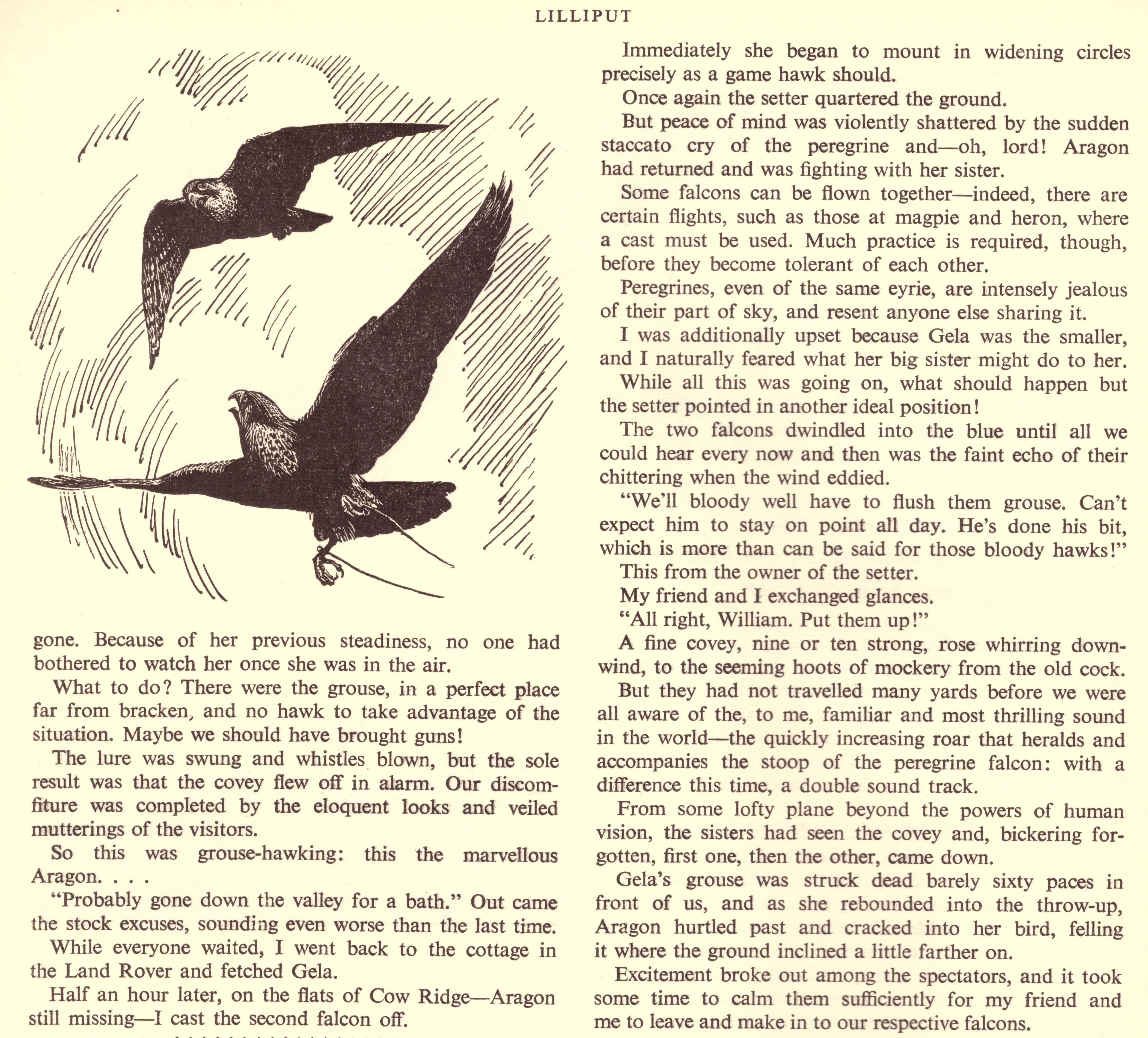
Lilliput changed from the pocket-sized magazine it was famous for, to a larger size more in-keeping with other magazines in January 1954. Pollard's last piece for Lilliput was  "Right and left" which appeared in January 1957 and told the tale of two eyasses which apparently  are "hawks which has been brought up from the nest, as distinguished from a hawk caught and trained". The two illustrations reflect Pollard's story where, when the two falcons are on the moor, a crowd might gather and secondly one bird which was lost, suddenly appears aggressively, protecting its part of the sky from its sister!

Christine Sheppard kindly let me photograph the original artwork for this story - crudely I have to confess, but that's my fault, but I still think worth showing
Note the Art Editor's annotations!

I found this article in an Australian newspaper:

THESE FALCONS GO TO WAR
Geoffrey Pollard is a barrister who has been interested in falconry for many years. In a BBC talk he spoke about this mediaeval pastime which, although long extinct as a sport, still exists amongst a small body of enthusiasts which has kept and trained hawks for hundreds of years. In nearly every war. including the last one, both sides have used trained falcons to Intercept enemy carrier pigeons. In 1947 and 1948 peregrine falcons were used on some United Kingdom aerodromes to clear them of birds before aircraft took off and landed. Seagulls were the worst offenders in standing about on the airfields and as peregrines would not chase them it was decided to get gyrfalcons from Iceland. Gyrfalcons are the largest, fastest and most powerful of all the falcon family.
FOUR FEET WINGS
"They are also the rarest," said Pollard, "Gyrs breed on and above the Arctic Circle and no bird that flies, not even the wild swan is safe from them. They have a wing span of rather more than four feet and the female, called the falcon as opposed to the male or "tiercel", which is smaller, weighs over four pounds. They can drive eagles with the ease of a collie driving sheep." From: Narromine News and Trangie Advocate (NSW), 3 February 1953, page 9 c/o Trove
Pollard, as it says above, gave a 15 minute talk on the BBC Home Service entitled "Gyrfalcons" on 26th September 1952, at 19:45. The Radio Times states 

Talk by Geoffrey Pollard
The speaker, one of the small band of falconers in this country, describes an expedition to northern Norway in search of young birds.

In 1939 Pollard is listed (with his birthday as 28 October 1926) as "at school" and residing at Chesterton, Melville Road, Falmouth, Cornwall.I presume it's his son who wrote this short piece for Blundell's School's website (accessed from the Old Blundellians). Pollard passed away on 15 October 2006 (in Rickmansworth) and was a pupil at the Devon school between 1941-1943

Geoffrey had a life-long interest in falconry and was one of the leading British falconers.  He set records for his bags of Red Grouse which he killed in the 60’s in Caithness with his team of Peregrines.
He was a successful criminal defence lawyer and was a frequent participant at Uxbridge Magistrates Court due to the close proximity to Heathrow and his office in Hayes, Middlesex.  In the 70’s he represented many drug traffickers and at least one hijacker!  When he passed away, Geoffrey was 11 days short of his 80th birthday.

Nick Pollard

There's a lovely tribute that also confirms the data above on the Peregrine Fund website where there's also a plaque dedicated to Pollard. It's easier to visit virtually as the memorial is in Idaho of all places! 

In conclusion... Raymond Sheppard was the perfect choice to draw illustrations for Pollard's works. I can't find any record of any authored books by Pollard but must mention one more article (for the completists) which appeared in Lilliput  July 1954 "The Passage Hawk on pp. 68-70 with an illustration by Oliver Heywood, thus not shown here.

The Passage Hawk, (ar) Lilliput July 1954

Saturday, 2 April 2022

Raymond Sheppard and Boy's Own Paper and Keith Horan

Boy's Own Paper May 1956, pp.26-27

Back in 2012, I showed the colour cover and inside illustration from Boy's Own Paper of May 1955. The story "The Red Fear" by Keith Horan was about how tigers and even elephants stand aside when packs of red dogs roam on the Deccan Plateau of southern India. 

Today I want to concentrate on the other three stories written by Keith Horan and illustrated by Sheppard. 

The April 1957 issue of Boy's Own Paper has "Terror of the Air"; May 1956 we have "The Masked Terror", January 1958 the story "Guardian of the Water-Gate" and in the issue dated June 1958 we sadly have not only Sheppard's last work for Boy's Own Paper but also a tribute to him in the story "The Monarch of Silver Pool".  

The first "The Masked Terror" (see above illustration) has some superb writing, engaging the reader with horror, whilst teaching subversively about nature:

Nearly two inches in length, it had a long, pointed body, ringed and armoured and ending in a sort of spike. lts thorax was also armoured and from it protruded six legs.  The back of its head consisted mostly of two black, staring globes of eyes, and the front, where its face and mouth should have been, was covered by a smooth, featureless mask split down the middle and reaching down to its breast. This mask, a combination of the Inquisition and the Klu-KIux-Klan, gave the monster a ghastly look of blank, mysterious horror.
Such terrors are Horan's description of the hunting skills and the insatiable hunger of the dragonfly larva!

Boy's Own Paper April 1957, p.26

The second is called "Terror of the air" and again is a tale of a dragonfly, but this time in the Himalayas. Again a voracious eater who eats things larger than itself!

Boy's Own Paper January 1958, p.18

"Guardian of the Water-gate" (January 1958)  is about a family of muskrat and the attack by a mink, who apparently cannot hold their breath as long as a muskrat. In the final battle depicted above, the muskrat father kills the attacking mink. Again the writing is tense, descriptive without being gruesome. 

Boy's Own Paper June 1958, p.18-19

Lastly we have "The Monarch of the Silver Pool" - who is a twenty inch long trout. We follow his adventures as a fingerling being caught by a fisherman who wisely puts the little trout back. we then read about a boy tickling the trout until a Bailiff comes along. Finally, grown up and as a 'monarch', an otter comes along with four webbed feet and a strong tail and an agility that finally leads to the Monarch's demise. 

On Monday the 21 April 1958, Raymond Sheppard passed away. Jack Cox, the Editor of Boy's Own Paper at the time, wrote the above tribute (with a few minor questionable facts).  Nevertheless it looks as if he must have known Sheppard, for this is quite affectionate and the only tribute I have so far seen in the magazine.

Getting back to Horan, he has two stories in Young Elizabethan that I know of ("Anek's Tapek "mentioned here) which are illustrated by Sheppard and after extensive searching in bibliographies and on the net, I have drawn a blank beyond this. There are various Horans in genealogical databases and the Times has a note of the engagement and wedding of "Pamela Horan only daughter of Lieutenant-Colonel Horan, late 43rd Light Infantry (Oxford & Buckinghamshire) and Mrs Guy Rickard of Liphook, Hants."  BUT I don't know if this is him.

If anyone knows more about Horan (what this a pseudonym?) and any details of his life - and why he wrote no books under that name! - please do get in touch.

BIBLIOGRAPHY

     Horan, Keith (fl. 1940s-1950s)

        * Men, Meal, and Memories, (ar) Blackwood’s Magazine May 1951, as by “Won-Tolla”
        * Fun and Game, (ss) Blackwood’s Magazine September 1951, as by “Won-Tolla”
        * Pictures in the Fire, (ss) Blackwood’s Magazine November 1951, as by “Won-Tolla”
        * The Letter, (ss) Britannia and Eve December 1951
        * Escape, (ss) Argosy (UK) April 1952
        * Stand By—Maternity Case!, (ss) John Bull December 5 1953
        * Kubosko, (ss) The Boy’s Own Paper June 1954
        *[Resurgam, The World's News, 20 Nov 1954]?
        * The Red Fear, (ss) The Boy’s Own Paper May 1955
        * My Friend Bunda, (ss) The Boy’s Own Paper August 1955
        * Death in the grass, The Boy's Own Paper, September 1955
        * The Masked Terror, (ss) The Boy’s Own Paper May 1956
        * Terror of the Air, (ss) The Boy’s Own Paper April 1957
        * Anek's Tapek by Keith Horan Young Elizabethan June 1957
        * Forests of the night, Young Elizabethan, January 1958
        * Guardian of the water-gate, The Boy’s Own Paper, January 1958
        * The Monarch of Silver Pool, The Boy’s Own Paper, June 1958
        * White Fury, (ss) The Boy’s Own Paper February 1961

Thanks to the invaluable FictionMags Index and my own added research

Other than this, he remains a very big mystery which is a shame as I really enjoyed reading his short stories of nature "in tooth and claw"!