Wednesday, 1 November 2017

Raymond Sheppard and Man-Eaters of Kumaon

Merlin Unwin 2017 illustrated edition
I have to declare straight away I received a copy of Jim Corbett's first published book from Merlin Unwin as a thank you for help I gave them regarding the Sheppard illustrations in this title. Having said that I have a copy from the 1950s and had always intended to read it before blogging about it! So thanks to Merlin Unwin I have now read my first Jim Corbett book! And what a read it was too!

Bibliographic details
Author: Jim Corbett
Illustrator: Raymond Sheppard
ISBN: 978-1-910723-43-2
Published: September 2017
Format: 216 x 138 mm
Binding: Hardback
No. of pages: 272
33 black & white illustrations
Price: £15.99
All royalties from UK sales of this edition of Man-Eaters of Kumaon go to tiger conservation at the Corbett Tiger Reserve, Uttarakhand, India.

All illustrations below are from my 1961 reprint of the 1952 edition by Oxford University Press


The cover of the first Sheppard illustrated edition of Man-Eaters of Kumaon

I expected the topic of hunting down man-eating tigers and the eighty-year old writing style to jar with me, but I was wrong! It was a sensitive, fascinating insight to a world I knew nothing about - beyond clichés. The geography, the cultures and particularly the awareness of nature and the environment kept my attention so much so that I could not put it down until getting to the end of each of his seven tiger stories. (There also a chapter on fishing and on his faithful Cocker Spaniel, Robin). This edition also, like earlier editions (and there have been quite a few!) has a map of the man-eater sites, a glossary of Indian terms, an author’s note - more on that shortly and and an additional piece that I don't have in my 1950s edition, of Corbett photographing tigers. The thing you need to know is these events all took place during a period in the earliest part of the 20th century when conservation of wildlife was not high on any country's agenda and Corbett was particularly sensitive to this.  His upbringing (he was born in the Nainital district, northeast India) was such that he knew the jungle very well and demonstrates in the book how to call a tiger towards you impersonating a potential mate. He preferred hunting alone as a man-eater can be very fast and unpredictable and sensibly he'd rather only rely on himself as a loaded rifle behind him might accidentally be fired in panic! As time went on Corbett saw hunters just out for 'sport' and hated the waste as even the dead animals would be left if not enough of a trophy for the hunter - not even rounded up and given to the local population for food.

Man-Eaters of Kumaon Frontispiece and Title Page

I usually scan all the Sheppard illustrations and share them here thanks to Christine Sheppard's ongoing permission. But as the publisher has gone to the trouble of re-typesetting the text and using Sheppard's illustrations I don't feel I should this time. So I'll limit my scans to the full page illustrations. But there are many smaller and equally gorgeous illos in the reprint.

Man-Eaters of Kumaon page 13

BIOGRAPHY
Edward James Corbett was born on the 25 July 1875 near the Kumaon foothills of the Himalayas, in the Nainital district now Uttar Pradesh and Uttarakhand during the days of the British rule in India. His father, William Christopher Corbett the Postmaster of Nainital died in 1879, when Jim Corbett was just 4, and he left his widow, - his second wife - Mary Jane Corbett (who died in 1924) with 8 children. Corbett was closest to his sister Margaret ('Maggie') Corbett. His early life was spent learning the skills of trekking and exploring that would serve him well when, from 1911 for 27 years, he tracked man-eating tigers (and leopards). A legacy enabled him to quit his railway job, and thereafter his income came from his estate agency business with rentals making up the bulk.

Man-Eaters of Kumaon page 29

It was Lady Violet Haig, who persuaded Corbett to commit his stories to paper, which he did in a self-published book entitled "Jungle Stories", this led to his amazing writing career. In the foreword to editions of his first commercially available work, Corbett makes clear that they are only 'man-eaters' because of injuries they have sustained, such as one tigress who encountered a porcupine whose quills embedded in one of her eyes. Also this may happen in very rare circumstances where their environment has been destroyed (by man!) which Corbett saw in the major de-forestation work around his beloved locality. I'm not sure the 1948 film of the book - although none of Corbett's stories were actually used - did anything to educate people on tigers' behaviour. The film starred Wendell Corey, now better known as the detective in Hitchcock's Rear Window. Perhaps Corbett received royalties for the use of his book title; perhaps it raised his profile at the time, but whatever the truth his stories still read as excellent sensitive writings on the thorny issue of hunting tigers (and leopards). His writings are still in print and many biographies have appeared over the years, the best being:

  • Kala, D.C. (1979). Jim Corbett of Kumaon New Delhi : Ankur Pub. House
  • Booth, M. (1986). Carpet Sahib: A Life of Jim Corbett London: Constable
The latter is the book on which Booth also wrote a screenplay - see below
Man-Eaters of Kumaon page 39

After the independence of India, in 1947, Corbett moved with his sister Maggie to Nyeri, Kenya, where he settled and continued to write and raise awareness of the declining numbers of tigers and other wildlife. On 19th April 1955, a few days after writing his sixth book Tree Tops, (which was also illustrated by Sheppard) Corbett died of a heart attack. He was buried at St. Peter's Anglican Church in Nyeri. His legacy began, with his books, but in 1957 the Ramganga tiger sanctuary was re-named in his honour as the Corbett National Park, The Corbett Museum is located at Choti Haldwani, 3 km form Kaladhungi, and there's a short video on YouTube of the Museum.

Talking of YouTube I was amazed to see some original film by Corbett (and of Corbett) and also the dramatisation of his work by the BBC,initially broadcast as Man-Eaters of Kumaon on BBC Two on 14 December 1986 at 19.15.  The accompanying Radio Times (13-19 December 1986) has a great cover of Corbett and there is a two page feature too on this Martin Booth  and John Elliot adaptation.
Radio Times 13-19 December 1986
Artwork by Bill Sanderson
Radio Times 13-19 December 1986 p4

Radio Times 13-19 December 1986 p5

Radio Times 13-19 December 1986 p41


Raymond Sheppard illustrated Man-Eaters of Kumaon in 1952, The Man-Eating Leopard of Rudraprayag in 1954, Tree Tops in 1955 and The Temple Tiger and more Man-Eaters of Kumaon in 1957. His illustrations have been reproduced in so many editions of these works I gave up trying to capture the data a long time ago and stuck to the originals


Man-Eaters of Kumaon page71

Man-Eaters of Kumaon page103

Man-Eaters of Kumaon page117

Man-Eaters of Kumaon page149

Man-Eaters of Kumaon page159

Man-Eaters of Kumaon page187

Man-Eaters of Kumaon page199

A select Bibliography (from the British Library holdings)
There are, in addition, to the books listed below a lot of 'mash-ups' of Corbett's writing including a graphic 'novel' for the Kindle plus several biographies, many published in Delhi, where his name is so revered even today for saving so many lives through his careful campaigns.


Man-eaters of Kumaon / Jim Corbett. S.l.]: S.l.] : O.U.P., 1944.
  • Man-Eaters of Kumaon ... With an introduction by Sir Maurice Hallett ... and a preface by Lord Linlithgow. Second edition.]. Madras: Madras : Oxford University Press, 1945.
  • Man-Eaters of Kumaon ... With a foreword by Lord Linlithgow. With plates, including a portrait.]. London: London : Oxford University Press, 1946.
  • Man-Eaters of Kumaon. Illustrated by Raymond Sheppard. London: London : Oxford University Press, 1952.
The Man-Eating Leopard of Rudraprayag / Jim Corbett. London: London : Oxford university press, 1948.
  • The Man-Eating Leopard of Rudraprayag, etc. With plates, including a portrait, and a map.]. London: London : Oxford University Press, 1948.
  • The Man-Eating Leopard of Rudraprayag. Illustrated by Raymond Sheppard. London: London : Oxford University Press, 1954.

My India. Impressions of the life and people of districts in Agra and Oudh and Bengal.]. London: London : Oxford University Press, 1952.

Jungle Lore. With a portrait.]. New York: New York : Oxford University Press, 1953.

  • Jungle Lore. With plates, including a portrait.]. London: London : Oxford University Press, 1953.
  • Jungle Lore. S.l.]: S.l.] : Oxford University Press, 1961.
  • Jungle lore / Jim Corbett ; with an introduction by Martin Booth. Delhi: Delhi : Oxford University Press, 1990.
Man against Man-Eaters. (Illustrated by Raymond Sheppard. Abridged from “The Man-Eaters of Kumaon,” and “The Man-Eating Leopard of Rudraprayag.”). London: London : Oxford University Press, 1954.


The Temple Tiger and more Man-Eaters of Kumaon. With plates.]. London: London : Oxford University Press, 1954.
  • The Temple Tiger, and more Man-Eaters of Kumaon ... Illustrated by Raymond Sheppard. London: London : Oxford University Press, 1957.
  • The Temple Tiger and more Man-Eaters of Kumaon / Jim Corbett ; illustrated by Raymond Sheppard. Bombay ; Oxford: Bombay ; Oxford : Oxford University Press, 1957 1982 printing].
  • Man-Eater! A condensation from The Temple Tiger and More Man-Eaters of Kumaon. (Illustrations by Bob Kuhn.).
Tree tops. S.l.]: S.l.] : O. U. P., 1955.
  • Tree Tops ... Illustrated by Raymond Sheppard. An account of the scenes witnessed by Queen Elizabeth and the Duke of Edinburgh on their visit to “Tree Tops,” Kenya, in 1952.]. London: London : Oxford University Press, 1955.
OTHER TITLES
  • Man-Eaters of India. (A Corbett omnibus, including Man-Eaters of Kumaon, The Man-Eating Leopard of Rudraprayag, The Temple Tiger and More Man-Eaters of Kumaon.) With a portrait.]. New York: New York : Oxford University Press, 1957.
  • Man-Eaters of Kumaon, and, The Temple Tiger, etc. London: London : Oxford University Press, 1960.
  • Man Against Man-Eaters. London: London : Oxford University press, 1964.
  • Jim Corbett's India / stories selected by R.E. Hawkins. Oxford: Oxford : Oxford University Press, 1978.
  • My India / Jim Corbett. Delhi ; Oxford: Delhi ; Oxford : Oxford University Press, 1989.
  • The Jim Corbett omnibus. Delhi ; Oxford: Delhi ; Oxford : Oxford University Press, 1991.
  • The second Jim Corbett omnibus. Delhi ; Oxford: Delhi ; Oxford : Oxford University Press, 1991.
  • The Oxford India illustrated Corbett / illustrated by Prashanto ... et al.]. New Delhi ; Oxford: New Delhi ; Oxford : Oxford University Press, 2004.
  • My Kumaon : uncollected writings / Jim Corbett. New Delhi: New Delhi : Oxford University Press, 2012.
Whilst wrapping this up I browsed the Merlin Unwin site and spotted that they have also reprinted some of one of my favourite author's books: 'BB' or Denys Watkins-Pitchford. Follow the link to have a browse

Man-Eaters of Kumaon page247

Monday, 18 September 2017

Raymond Sheppard and Blackies Childrens Annual

Animals and Birds "page 5"
 I have mentioned several times how frustrating collecting Raymond Sheppard's work for Blackie and Son Limited is, due to there re-packaging stories in different books, using his pictures again and again with different captions to suit different stories and just reprinting his work anywhere they can in compilation-type storybooks.

So allow me to say it again.... ignore my ranting and enjoy the master at work....

I bought this hardback - and by that I mean 'board' book, i.e. solid boards all through the book - and found I already had the picture listed. But the other pictures are gorgeous enough for me to slide them over to my other blog where I post such things when time and inclination allows!

Animals and birds - unknown artist

But back to Raymond Sheppard. Animals and birds was published Blackie and Son Ltd. The British Library received a copy in 1937 so let's go with that being the closest date we can get. Booksellers usually identify an undated book like this by the title of the first story, but here we only have picture captions, so "Parrots". The picture above appears as the fifth entry inside the book and shows the caption "Now you look lovely!" as a young girl ties a ribbon round a calf - with a hen and chicks in the foreground. What I love about this is the clear colouring and the strange attention to detail - what is the 'cage'-like object just out of sight? Why do there appear to be leaves hanging right by the door to the stall? And is the girl going to place her calf in a show?

Anyway, this picture also featured in Blackie's Children's Annual (33rd year as it says in the book, but based on an inscription in my copy "1936" - first story is titled "The King's Mail"). But let's go through all Sheppard's illustrations in this latter book

Blackie's Children's Annual #33 (Published 1936?)

Blackie's Children's Annual #33
"Flitter-mouse" by Elizabeth Gould

Elizabeth, Cynthia and Ted  are in the garden when suddenly a bat swoops by. Cynthia had never heard the name flitter-mousie before so the others explain how Old Shepherd captured a bat once and showed it to them, feeding it insects and watching it comb its fur. The children are glad they don't need to hang upside-down when going to bed. I still have no further information on Elizabeth Gould even though she was so prolific at Blackie and Son.
Illustration reprinted in Tales about animals.


The next illustration is captioned "Now you do look pretty" and is the same as the one at the top of this article. It's placed between "The Runaways: An Eastern Play" and "Mrs Mulberry's Money-Box" neither of which is relevant to the illustration. I couldn't find a story to which it might belong.

Blackie's Children's Annual #33
"The Revolt of the Donkeys" by Clarissa Lorenz
Over-loaded

Blackie's Children's Annual #33
"The Revolt of the Donkeys" by Clarissa Lorenz
The donkeys won't come down

Blackie's Children's Annual #33
"The Revolt of the Donkeys" by Clarissa Lorenz
"How glad I am to see you back!"

"The Revolt of the Donkeys" is written by Clarissa Lorenz - the only thing I could find about this author was a mention of a Clarissa M. Lorenz who was married to Conrad Aiken, an American poet, whose correspondence to and from this wife is held in Harvard University. Some of these papers include translations from Spanish so I don't think it's too far-fetched to connect the two ladies. She was a musician and journalist. The Georgia Encyclopedia mentions "Aiken's second wife, Clarissa M. Lorenz, vividly described in her book Lorelei Two: My Life with Conrad Aiken the psychological difficulties the author had in the 1930s, when the couple was living in England. She wrote of having once saved the poet from suicide". At 11 Aiken's father changed personality suddenly and shot his wife and himself. We also learn that Aiken settled for a time in Rye on the Isle of Wight and met another woman with whom he later married and returned to the States. Lorenz's biography spans the years of 1926-1936 (they were married from 1930-1937) and a little beyond the end of their marriage. Clarissa died 16 May 1992. The reference to 'Lorelei' is the device Aiken used in his book Ushant when naming his three wives, Lorenz being 'Lorelei Two'. One other reason  I'm associating this Lorenz with ours is a comment in the Horn Book magazine of  in an article "Radio's Ugly Duckling." (Sept.-Oct. 1939: pp279-85) where she writes:
One cause of bad programs is radio's complete identification with the machinery of advertising, which limits it as an instrument for diffusing culture. In radio, culture and commerce have knocked heads together with a horrid bang. Since radio economy is based on advertising, the bank balance alone is dictator. One of the most powerful advertising agencies in the country chooses its programs by subjecting a highly cultured couple to a workout. If a program really makes them suffer, the manager promptly signs it up, for he knows it will go over big. The most popular programs today appeal to a child's sensationalism and are designed to bring in box-top returns, with nightmares and unhealthy emotions as a result, plus an avalanche of unused products on the pantry shelf.
This makes me thinks she has some association with children and the media they imbibe. If I'm completely wrong, I'd love to know.

Anyway the story claims to be an old tale of a village where the donkey-owners treat their animals cruelly and the donkeys, decide amongst themselves to go on strike and climb the highest mountain so they cannot be reached. Eventually the owners see the errors of their ways and the donkeys return.


Blackie's Children's Annual #33
'Father William' by Elizabeth Gould

This is a two page story about a proud, possessive and competitive cockerel, by Elizabeth Gould. The last story Sheppard illustrates in the book is "The Grateful Stork" by E. L. Westmorland, another author I can't find any information on.

Blackie's Children's Annual #33
'The Grateful Stork' by E. L. Westmorland
 This lovely short tale of a Bretta Olsen's appreciation of the storks nesting on her parents' chimney is interesting in that it's set, I guess in Denmark as they mention Thorvig Point - which I can't find, but Thorvig is a common first name in Denmark. The father and daughter nurse a young stork who has a broken leg and it flies off, in time, to join the rest migrating south. The following year they find a twig dropped on the garden and they plant it to see what happens. It turns out to be honeysuckle - "Storks are grateful birds" says the father.
 
Blackie's Children's Annual #33
'The Grateful Stork' by E. L. Westmorland


Monday, 21 August 2017

AUCTION: Black Beauty in Girl comic

Raymond Sheppard illustrated a little seen strip in Girl comic, a companion for....girls, to the famous Eagle comic begun by Rev Marcus Morris and Frank Hampson, the creator of "Dan Dare".

Heritage Auctions, in the United States, has an original artwork by Sheppard from this strip.

"Black Beauty" by Raymond Sheppard
Girl Volume 1:8, 21 Dec 1951
The series ran from the first issue of Girl on 2 November 1951 (Volume 1: 1) until 29 February 1952 (Volume 1: 18). It was published on the centrespread of the comic (down the left hand column) along with John Ryan's "Lettice Leef" among other features. Ryan, of course was the creator of "Captain Pugwash". As can be seen this is episode 8 of the story by Anna Sewell.

This gives me the opportunity to show you all the pictures I have of this series. If anyone wants to share any other parts, I'd be enormously grateful

Part of the original centrespread for Girl Volume 1:1
Girl 23 Nov 1951 Volume 1:4
Original art from an eBay picture of issue 7

Issue 7 artwork
Unknown episode

The auction ends on Sunday 27 August and I'll record here how much it sells for

Black Beauty Girl Volume 1: 8
WHERE?: Heritage Sunday Internet Comics Auction #121735
LOT #: 14103 
SELLER:Heritage
STARTING BID:$
ENDING PRICE:$131.45 (inc. Buyer's Premium) = £101.66
No of bids: 3

END DATE: 27 August 2017

Saturday, 29 July 2017

Raymond Sheppard Auctions

Just a quick article on the auctions running at the moment

The first is an unusual drawing of a feeding lioness which is on auction at Bellmans in Billinghurst. Lot #1551 has an estimate of £150-£250 and has a description:
"Raymond Sheppard (1913-1958), Lioness, pen ink and wash, signed, inscribed on mount, unframed, 17cm x 22.5cm., DDS"
The whole auction is running on Full details are available on The Saleroom and Bellmans

Raymond Sheppard - Lioness feeding
The inscription below on the card frame says:
"To G. S. Whittet esq.
With all best wishes 
for Christmas and the new year
from
Raymond Sheppard"

It appears that G.S. Whittet was the Editor of the prestigious Studio magazine. Sheppard produced an article for the magazine and wrote three books for their book imprint, more on them another day,

George Sorley Whittet (1913- ?)  authored various articles for the magazine but also various books
  • Art Centres of the World. London: Michael Joseph, 1967
    Basil Alkazzi: recent paintings 1984, 1985, 1986.New York: Schiller-Wapner Galleries 1987
  • Bouquet: A Galaxy of Flower Painting London: Studio Publications 1949
  • Eduard Wiiralt.Stockholm, Eesti Raamat, [1948]
  • John Armstrong. (Preface by Whittet) London: Lords Gallery, 1963.
  • Lovers in Art London: Studio Vista, 1972
  • Mystic Dreamscapes: The Art of Basil Alkazzi Brooklyn, Conn.: Museum NECCA, New England Center for Contemporary Art, c1988.
  • Noêmia Guerra, Paris: Galerie Jacques Massol (Préface par Georges S. Whittet), 1966.
  • Vincent and William Apap: sculpture and painting (Grabowski Gallery (London))
    Malta: Progress Press, 1962.
  • "Horses in art" in Horses, horses, horses, horses.London: Paul Hamlyn [1962]
  • "The ship in art" in Ships by Robina Farbrother. London: Paul Hamlyn, [1963]
---------------------------------------

Date: 02 Aug 2017 11:00 BST
Estimate: £150-£250
Where: Bellmans
---------------------------------------

The second auction is from Burstow & Hewett (in Battle) and available via The Saleroom. It's a nice watercolour of Michael and Christine, Sheppard's children, posing on the floor of "the front room" together with a black and white sketch of young Michael reaching the door handle

Raymond Sheppard - Michael and Christine
plus Michael reaching for the door handle
Lot #326 is described:
Raymond Sheppard (1913-1958), watercolour, Michael and Christine in the front room, circa 1950, 10'' x 14'', framed.


---------------------------------------
Date: 02 Aug 2017 14:00 BST
Estimate: £200-£300
Where: Burstow & Hewett
---------------------------------------

Four items by Raymond Sheppard
And lastly a collection of 4 items in one lot (#219) Again this is at Burstow and Hewett and The SaleRoom  have a group of four drawings including two of the family and two of animals

Its brief description states:
Raymond Sheppard (1913-1958), 4 pencil and crayon drawings, studies of children and animals, mounted, (4).
We can see an interesting 'blue' picture which is  a very young Christine Sheppard and the coloured wash is of the family gathered around Iris, their Mum. But also their are sketches of an otter(?) and two seals (?) as well as what looks to me to be studies of a ferret.

---------------------------------------
Date: 02 Aug 2017 14:00 BST
Estimate: £100-£150
Where: Burstow & Hewett
---------------------------------------

Saturday, 1 July 2017

Raymond Sheppard and Gunby Hadath (Part Two)

In the previous blog article I outlined Gunby Hadath's biography and showed a few of Raymond Sheppard's accompanying illustrations to his 6 part story which began in April 1940 edition of the Boy's Own Paper.


Here are the remainder of illustrations accompanying the story "In search of a kingdom" by Gunby Hadath spread over 6 months of Boy's Own Paper. It's interesting to note not only Sheppard's technique here (almost a negative of a scraperboard technique) but also the way in which the editor decided to wrap text around the images - something so much easier to do now in the age of computers, than back then! The full page wash of St. Bernard is incredible as it stands out in the whole run and considering paper shortages during the war gives testimony to the esteem in which Sheppard was held.

MAY 1940
Boy's Own Paper May 1940 p.357
"He dropped his hand on the gunwale of Michael's light skiff
 and tilted it forward to let the water pour in" 

Boy's Own Paper May 1940 p.358
"Glancing about as he went, he discerned de Bellecombe 
 seated by himself on a bench "

Boy's Own Paper May 1940 p.360-361
"They were joined by a forester who was leading a mule 
in the shafts of a two-wheeled cart"
Boy's Own Paper May 1940 p.366
Donkey and cart

JUNE 1940

Boy's Own Paper June 1940 p.406 
Greitmann leaned forward across the table. He looked straight at de Varges.
"I have no use for braggarts", he said
Boy's Own Paper June 1940 p.409
The brigand chief was leaning against that column,
with his arms folded, jeering at St Bernard
Boy's Own Paper June 1940 p.413
A man, with one arm twisted under him and unconscious
Boy's Own Paper June 1940 p.415
A St. Bernard dog


JULY 1940

Boy's Own Paper July 1940 p.439
"Above the town the ancient chateau was frowning"
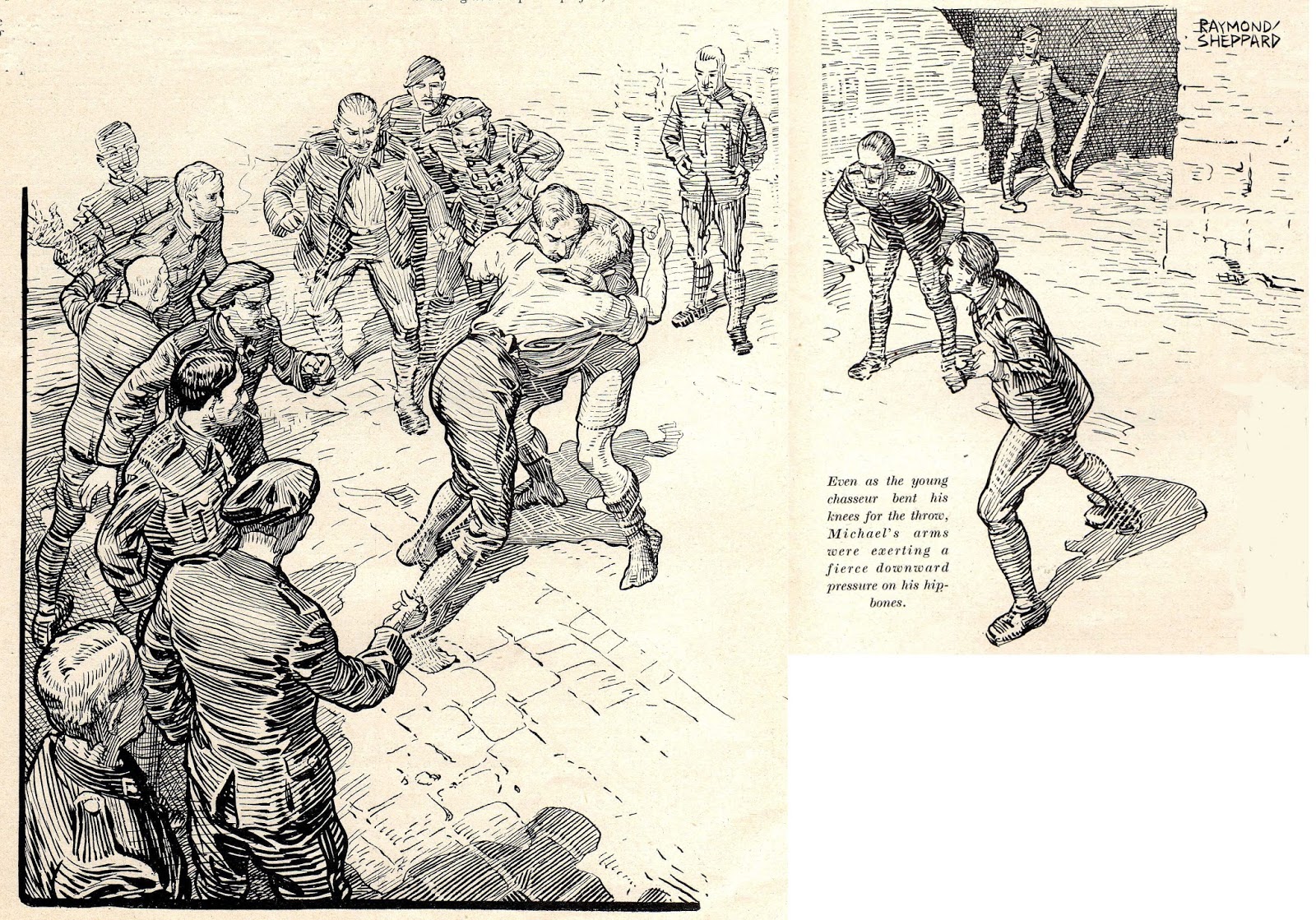
Boy's Own Paper July 1940 p.444-445
" Even as the young chasseur bent his knees for the throw
Michael's arms were exerting a fierce downward pressure on his hip-bones"
Boy's Own Paper July 1940 p.447"Michael took the plunge. “I'm being chased, sir”, he said,
“by some scoundrels who want to get rid of me”" 

Boy's Own Paper July 1940 p.449"Colonel St. Armaund"
 AUGUST 1940
Boy's Own Paper August 1940 p.469" He had wrangled a lift with the baggage and slept like a top"

Boy's Own Paper August 1940 p.471"When Michael's turn came to slake his thirst from the gourd
he found the water quite warm"

Boy's Own Paper August 1940 p.474
"Dubois, Sergeant of Chasseurs"

Boy's Own Paper August 1940 p.477
"You refuse!" gasped Simon Greitmann"
SEPTEMBER 1940
Boy's Own Paper September 1940 p.494
"Here he was with the compartment to himself...while poor Antoine..." 
Boy's Own Paper September 1940 p.497
"The innkeeper bowed low as Michael came up"


Boy's Own Paper September 1940 p.498-499
" Numbers of them were shaking their fists as they screamed"

Boy's Own Paper September 1940 p.501

Although I have not found any more Gunby Hadath tales that Sheppard illustrated in Boy's Own Paper, Sheppard did illustrate a book, Blue Berets, and that raised an interesting issue.

I have a copy,  with no dustjacket, and remembered there were illustrations in it, but until looking at it for purposes of finishing this article, I had not realised - and there is no clue in the book - that this is in fact "In search of a kingdom", published one year later by Lutterworth (who at the time owned the Boy's Own Paper!
So I might as well list the differences and satisfy my complete cataloguing fetish!

BLUE BERETS

The following illustrations appear in the book on the following pages with their corresponding months in BOP:
Page 10: see April p.307
Page 48: (no caption) see May p.357
Pages 68-69: (no caption) see May p.360-361
Page 83: (no caption) see May p.366
Page 94: see June p.406
Page 142: Caption changed to "Above the town frowned the ancient chateau" see July p.442
Page 161: (no caption) see July p.447
Page 189: (no caption) see August p.474
Page 224: (no caption) see September p.494
Page 243: Caption changed to "It was Perigord, his host, white-headed and rubicund" see September p.497
Page 253: (no caption) see August p.469


Saturday, 13 May 2017

Raymond Sheppard and Gunby Hadath

GUNBY HADATH (1871-1954)

Raymond Sheppard from Boy's Own Paper April 1940
In my first Sheppard blog article I showed a lovely colour cover by Sheppard of a charging tiger. I was wondering what to write about next and realised I haven't returned to Boy's Own Paper (BOP). Collecting magazines like BOP one starts to get to know artists very well but also author names (turn up again and again). One that appears a lot in the issues where Sheppard began illustrating is Gunby Hadath (1871–1954), or John Edward Gunby Hadath as he was christened. He also had pseudonyms, such as John Mowbray, Shepherd [or Shepperd] Pearson, James Duncan, and Felix O’Grady and was born in Owersby, Lincolnshire. Caistor, is also in one account but this is incorrect. However, both towns are roughly eight miles apart so one can understand why this confusion occurs. He began as a journalist, a correspondent for provincial papers, then London correspondent for the Italian press. He also wrote many lyrics to music (five of which are mentioned on the Havergal Brian Society pages as being 'lost') and 46 catalogued in the cooperative WorldCat.  He also wrote a number of songs such as 'Today and Tomorrow' [c1895-6], 'At Candlelight', 'Without You' and 'Song of Betrothal' and his most lasting, "Down the vale"

Raymond Sheppard Boy's Own Paper July 1938, p. 492

However he is best known for his public school stories as well as his adventure stories (as was another name seen with Hadath, Percy F. Westerman - more on him another day!). The British Library, at a very quick glance, lists 67 books with annuals, compilations etc, attributed to him and I suspect there's a lot more. Some sites quote 100 titles. If we add the "Pamela" series of books written under his female pseudonym, Florence Gunby Hadath (his wife's name, thus causing a lot of confusion for bibliophiles!) we easily get a bigger total and that leaves out all the short stories that were not reprinted in book form! He wrote "in periodicals such as ChumsHappy Mag., and The Captain". From: http://www.crimefictioniv.com/Part_34.html. He also had stories serialized in The Children's Newspaper.

He was athletic, and Captain of his school, St. Edmund's Canterbury and won College Colours for cricket, rugby and soccer at Peterhouse College, Cambridge University and was awarded his Master of Arts on January 16, 1896 (see Times 17 Jan. 1896, p.6). He followed a sporting career until his trial for Paignton Rugby Club when he had an accident which put paid to his sporting career.  He became Senior Classical Mas­ter at the Guildford Grammar School *.

Raymond Sheppard Boy's Own Paper July 1938, p. 494
"Planting his feet, he stationed himself in front of her, gripping his stick"

The Musical Times (1 August 1900 p.528) contains an appeal and update on a collection for Signor Piccolomini "the well known song composer, is, we are sorry to learn, seriously and distressingly ill. He is sixty-six years of age and, through the misfortunes of ill-health and failing powers, he is unfortunately without means. As his wife and her three young children are totally unprovided for, a fund has been started with a view of procuring a livelihood for Madame Piccolomini and her little ones, and of providing a home for her husband should he become sufficiently restored to be able to return to it. Nine donations already received, amounting to forty-two guineas, have given the fund a good impetus, and further subscriptions will be gratefully received and acknowledged by Mr. Gunby Hadath, 39, Chichele Road, Cricklewood, N.W" In the same year, he played cricket for the Authors against the Publishers at Lord's in 1911 and 1912 as well as appearing in a charity match for W. Strutt-Cavell's XI against XVIII of Twickenham in 1900.

Boy's Own Paper April 1940 p.307
"There had slipped out, brushing greasy elbows with him, two men who were whispering together"
After teaching for a while he appears to have been declared bankrupt in 1910. "The bankrupt had been a schoolmaster, the secretary of companies, a director of companies and journalist and since 1896 had earned between £1,300 and £1,400 by song-writing" The Times of February 11 1910 goes on to say "the bankrupt stated his failure was due to him having lost £1,985 17s 5d. through speculating on the Stock Exchange". In July (29th) that year it was further reported that despite clearing a lot of the outstanding debt the Registrar suspended the discharge for two years.

I like to think this is what prompted Gunby Hadath to start writing stories about his happier (?) times as a schoolmaster. Jack Cox writes in his history of BOP (Take a Cold Tub, Sir!) "His first story, "Buffle's Brolly" was published by Hutchinson in [...] 1909-10 and his last, "The decent old bird", was written for me [as Editor] in late 1953"

Boy's Own Paper April 1940 p.308-309
"Within the space of a breath the reptile had moved and wound its coils 
into a spiral, with neck extended and vicious head reared and swaying"
He also wrote to the Observer (February 18, 1923) requesting that London be given a "cleaning and painting" in honour of Sir Christopher Wren's bi-centennial
A somewhat unusual distinction has just come the way of Mr. Gunby Hadath, the writer for young people, who has been presented with the Freedom of St. Gervais-les-Bains, in Savoy, at the foot of Mont Blanc. Mr. Hadath resides on Mont Blanc during the summer months, and his "St. Palfry's Cross," which depicts the neighbourhood, has sold largely in America and Scandanavia, and is now being translated into French by Madame de Sailly.  From:P-P, De V. (1933), "Words confused and misused", The Bookman, vol. 83, no. 497, pp. 445.
Boy's Own Paper April 1940 p.308-309
"With the eerie sensation of being under inspection 
Michael called up that he had come in search of a room"
In the Collector's Digest March 1954 (Vol 8:87, pp62-63) a tribute appeared for Hadath:
There recently died Gunby Hadath who for a great many years was. in the front rank of authors for boys. He was particularly popular with his school stories. He started to write for "The Captain" in 1909 and continued to do so until its end in 1924. Later he wrote for "Chums". Practically all his serials were afterwards published in book form. Probably his best known story was "Sparrow in Search of Expulsion."
In his youth he was a well known cricket and rugger player. He rose to the rank of major in the First World War. He also wrote many popular lyrics, including "Down the Vale," which had a great vogue. I well remember a busker who used to sing it outside the old Bradford Empire 40 years ago. It was apparently the only song he knew. 
In a tribute which appeared in "The Times" Feb. 1st, "A.S.M." said he was in Gunby Hadath's form at a private school in Devon, where he was an assistant master just down from Cambridge. They started a friendship, which lasted right to Hadath's death. He concludes: "Of irrepressible vivacity and high spirits, come weal or woe, he was one of those usually dreadful people who are "hearty" at breakfast, that meal at which the characteristic Englishman sits dourly over his newspaper glowering upon all who make chatter, much less joke - but not upon old Gunby. I have known him burst into such a glum assembly wearing a bowler hat, boxing gloves, and Father Christmas white beard. With his passing much laughter has gone out of the lives of all who knew him; profoundest sadness descended upon his wife, who, alone able to read his handwriting, typed all his inimitable school stories and upon her twin sister, long time matron at Dulwich, who joined with them to make the happiest trio to which I have had the privilege of admission."
Gunby Hadath lived at Cricklewood but spent winter in the French Alps for many years. He must have been in his early eighties at the time of his death.
The Times 18 January 1954, (p. 8) announce his death and the following day a fuller obituary appeared in which it states he died at 82 years of age and was born on April 30 1871

OBITUARY:
MR. GUNBY HADATH whose contributions to the Boy's Own Paper and other publications of a similar nature will be recalled, died on Sunday in hospital in London at the age of 82, as briefly reported yesterday.
John Edward Gunby Hadath was born on April 30, 1871, the son of the late Rev. E. E. Hadath, sometime rector of Owersby, Lincolnshire. He was educated at St. Edmund's School, Canterbury, and Peterhouse. Cambridge, and began his career as a schoolmaster. His gift for clear exposition was soon manifested in writing, and he was able in due course to give up the classroom and transfer his work to the study, so that in time his name became one of the best known and best loved of those who aim to instruct as well as entertain youth. Many of his numerous stories appeared in serial form in the Boy's Own Paper,and were later republished as books to delight many generations of boys to whom Brent of Gatehouse, Last of his Line, Outlaws of St. Martyn's, Won by a Try and Schoolboy Grit have been household words for years. Besides his articles and stories, he wrote a number of lyrics, the best known of which is "Down the Vale" which in its musical setting had many years of popularity, and he also wrote for the theatre. For some years past he had divided his time between this country and France and since 1932 had been a Citoyen d'Honneur of the Commune of St. Gervaise-les-Bains, Haute Savoie.He married Florence Annie, the youngest daughter of the late William Webber, who survives him.
Let's get started with the Sheppard illustrated stories. The first I've found is "The mountain's dread hour" by Gunby Hadath (Boy's Own Paper July 1938). The two illustrations (shown above) are of a mountain eagle and it attacking two people on a ledge. All the other illustrations here are from Boy's Own Paper April 1940, Sheppard drew images to accompany Hadath's story "In search of a kingdom". Both stories are based on Hadath's experiences in the mountains of France.

Boy's Own Paper April 1940 p.315
NEXT: More of "In search of a kingdom"
===============================
* A lot of the early biography is adapted from Leonard M. Allen's article in The Story Book Collector No 33 January 1949