Thursday, 21 August 2014

Raymond Sheppard and Reynold's News and Sunday Citizen (Part Two)

Lopatkin, amateur inventor - Drawn by Raymond Sheppard
In my previous article on Reynold's News I covered some of the history of the paper. This time I want to highlight a book that was reproduced in six parts in the weekly newspaper, and illustrated by Raymond Sheppard... Not by bread alone (Trans. Dr. Edith Bone. New York: E. P. Dutton 1957; London: Hutchinson) written by the Ukrainian-born Dudintsev. The Times carried a review in 1956 under the title "Little Stalins" criticised in new Russian novel

Vladimir Dudintsev (July 29, 1918 - July 23, 1998)
From Wikipedia
The episodes in Reynold's News ran from Sunday 6 October 1957 to 10 November 1957 on pages 2 and 3 (except for the last two where it was relegated to pages 8 and 9). Sheppard's cameos of the three lead characters were reproduced throughout in the catch-up summary of the story each week - examples below

Reynold's News 1957 Oct 27 p2

The excellent SovietLit site has a précis of the book and a very short summary is:

An inventor named Lopatkin struggles against entrenched bureaucracy and self-servers in an attempt to help the Soviet pipe industry. He wins his personal battle, but the "invisible empire" of the bureaucracy remains intact and Lopatkin knows that a long struggle still lies ahead.

A contemporary reviewer (*1) says of the lead character: Lopatkin has some slightly crankish features, as inventors frequently have; he commands our sympathy by his honesty and devotion and by comparison  with the very  different character of his opponents.

The furore around the book happened in the Soviet bloc and in the West where both polar extremes grabbed the bits they wanted for propaganda purposes. Another reviewer (*2) from 1958 this time:


SovietLit:

This dismayed Dudintsev, making him feel "as though my novel, a peaceable ship in foreign waters, had been seized by pirates and was flying the skull and crossbones." He did not deny portraying negative aspects of Soviet society, but he said: We speak boldly and honestly about our deficiencies and our difficulties, because they are the birth pangs of a new world in which there is no injustice, a world the principals of which are being confirmed and marching to victory in my country."

Our Correspondent. "Foreign Publication Of Novel."
Times [London, England] 30 Mar. 1957 p.5.


The first double page spread
showing Lopatkin, Drozdov – the tough boss of the factory
 and Nadia- beautiful second wife of Drzdov
Reynold's News 1957 Nov 3 p8
Due to the nature of my photocopies I shall show them below with the original photos I took of Christine Sheppard's cuttings of her Father's work.

Reynold's News 1957 Oct 13 p2
Reynold's News 1957 Oct 13 p3
Christine's cutting of the above
'Poor fellow, he is a failure...Everyone is attacking him...'
Seven women talking in an office with a sofa and bookcase in background – Russian man enters

Reynold's News 1957 Oct 20 p3

Christine's cutting of the above
'Suddenly he felt like a teacher again'
Six men sit and listen, a woman takes notes as a teacher points to the board

Reynold's News 1957 Oct 27 p3

Christine's cutting of the above
'Lopatkin averted his eyes from the brief-case and said “We shall not accept anything more from you!”Man in check shirt and striped trousers in foreground and woman closes briefcase and older bearded man behind smokes
Reynold's News 1957 Nov 3 p8

Christine's cutting of the above
'Yes, he has been arrested!'Man behind desk points at woman
Reynold's News 1957 Nov 10 p8

Christine's cutting of the above
'After the first seconds Nadia gained self-control...'
Woman in striped dress hugs man in uniform
Nadia
In his obituary in the Times it was said:
"[Dudintsev] will rank in the history of Soviet literature as one of the central figures of a literary movement that took shape during the three years after Stalin's death in 1953and which was quickly branded 'revisionist' by the Communist Party - and even partly blamed for what happened in Hungary and Poland in the autumn of 1956."

----------------------------------------------------------------------------------------------------------------
*1 'R.S.', Two Literary Treatments of Pressing Social Problems Soviet Studies, Vol. 8, No. 4 (Apr., 1957), pp. 437-449 

*2 Sidney Monas The Private Muse: Some Notes on Recent Russian Literature The Hudson Review, Vol. 11, No. 1 (Spring, 1958), pp. 101-109 

Read more:
Our Moscow Correspondent. "Trails Of A Lone Inventor."  Times [London, England] 10 Dec. 1956: Page 11
"Russian Novelist's Complaint." Times [London, England] 7 May 1957: Page 12
Obituary: "Vladimir Dudintsev." Times [London, England] 17 Aug. 1998: Page 23

Wednesday, 13 August 2014

Raymond Sheppard and Reynold's News and Sunday Citizen (Part One)

Reynolds News was a weekly Sunday newspaper in which Raymond Sheppard did some lovely illustrations. I have browsed the whole of 1957 and until I came to July there were few editorial cartoons, let alone illustrations to stories. Jon Marshall has lots of caricatures of leading politicians from 1957 - MacMillan appearing a few times.
Reynold's News 1957 July 21
Crusoes of Sunday Island by Elsie K. Morton
A crude scan of a photocopy!

Thanks to Christine Sheppard preserving cuttings that her Father (or Mother) made at the time of publication we have access to clearer representations than scans from the British Library. Sheppard drew for so many publications and exhibited many times we may never find some of this information except for those tiny leads that take us in the right direction. I now own photocopies of the pages from this newspaper but as can be seen above the original newsprint does not lend itself to easy reproduction (especially from a microfilm!). Fortunately Christine has her original cuttings. All clearer images below are my photos of cuttings so they are not flat, but based on 14 years of searching I own not a single original newspaper and I think it very unlikely that even if I owned one that the images would be clearer than Christine's cuttings.

Reynold's News 1957 July 21
Crusoes of Sunday Island by Elsie K. Morton

The University of Bradford helpfully outlines the history of this unusual paper.

"Reynolds's Weekly Newspaper" was founded by the radical journalist George William MacArthur Reynolds in May 1850. It soon became a very successful Sunday newspaper, especially in the North of England, with a radical working class approach combined with sensationalism.
The Reynolds family retained the paper until 1894, when, under proprietor Sir Henry Dalziel and editor William Thompson, "Reynolds's Newspaper" became the Sunday paper that reflect[ed] the Liberal Party's views. In 1925, the paper's change of name to "Reynold's Illustrated News" reflected the growing importance of pictorial content in news coverage.
The paper was later acquired by the National Co-operative Press on behalf of the Labour Party, becoming the Sunday voice of opposition as "Reynolds News and Sunday Citizen". It ceased publication in 1967, by which time it was known as "Sunday Citizen".
The full history of the changing names of the paper, as far as we can ascertain from the collection at Bradford:
  • Reynolds’s Weekly Newspaper from 18 August 1850 to 9 February 1851
  • Reynolds’s Newspaper from 16 February 1851 to 25 February 1923
  • Reynolds’s from 4 March 1923 to 30 September 1923 (with interior page heading Reynolds’s News)
  • Reynolds’s News from 7 October 1923 to 21 September 1924
  • Reynolds’s Illustrated News from 28 September 1924 to 23 February 1936
  • Reynolds News from 1 March 1936 to 13 August 1944
  • Reynolds News and Sunday Citizen from 20 August 1944 to 16 September 1962
  • Sunday Citizen and Reynolds News from 23 September 1962 to 14 February 1965
  • Sunday Citizen incorporating Reynolds News from 21 February 1965 (to December 1965, latest issue held).

Reynold's News 1957 July 28

In my later research into the Sixties version I noted that the slogan of The Sunday Citizen newspaper (note: not a magazine), calling itself a democratic socialist weekly paper, is "The government of the people by the people". The Sunday Extra was a 4 page pullout "for the young and all the young at heart"  - a free comic supplement to the Sunday Citizen which contained comic strips by the likes of John Burns, Frank Langford and Frank Bellamy's one page summary of Poe's 'Pit and the Pendulum'.

But in the Fifties, when Sheppard did his illustrations the paper only had 12 pages, 3 of them sport so the inclusion of a serialised book was unusual.

Reynold's News 1957 August 4

The illustrations above accompanied Crusoes of Sunday Island by Elsie K. Morton and the full text is available online  thanks to Victoria the University of Wellington, New Zealand, we can read the author's preface:

Crusoes of Sunday Island is a factual account of the experiences and adventures of the Bell family on Sunday Island presented in story form. It is neither a documentary recital of their misfortunes and achievements, nor a personal history of the family, but is based on the actual happenings as related to me by Mrs. Bessie Dyke, Thomas Bell's's oldest surviving daughter, co-heroine of the story with her elder sister Hettie, the late Mrs. G. Gelderd.

Mrs. Dyke, now in her eighty-ninth year, possesses a remarkable memory, and has told in full detail the story of her extraordinary childhood and of her parents' heart-breaking misfortunes in the early years of their Sunday Island sojourn.

As the only surviving member of the family possessing personal memories of the ill-starred Denham Bay landing in 1878, and of the annexation of the island to New Zealand nine years later, she has given me permission to use the facts of her story as I see fit. Every episode related in the book, also the descriptions of Sunday Island as it was eighty years ago, are therefore based on fact, and follow as closely as possible Mrs. Dyke's own reminiscences.

It has obviously been impossible in every instance to record actual dialogue, but in many cases, conversations have been given in the exact words used by Mrs. Dyke. Elsewhere I have made a sincere attempt to suggest the manner in which this courageous family reacted to their often hostile environment, how they talked, and sometimes what they may have thought.

This story of an actual family's adventures obviously cannot be compared as a work of literature with Robinson Crusoe nor with the uninhibited invention of The Swiss Family Robinson. But I hope that its authenticity may win it a place of its own in the never-too-full shelf of desert island books.

The interest of the Bell saga lies in its grim realism, from the day Thomas Bell landed with his family on Sunday Island's surf-swept shore to his embittered departure thirty-five years later.


Elsie K. Morton (1885 - 1968) - was born Katherine Elizabeth Morton and this story of the Bell family tells how they settled between 1868-1904 on Raoul Island, known also as Sunday Island
Reynold's News 1957 August 11

Friday, 18 July 2014

Raymond Sheppard and Everybody's Weekly (Part One)

I've decided to turn off 'Lightbox' on this blog, so now you just click on the image to see the larger version

Everybody's 1953 May 2 Cover

Everybody's 1953 May 2 page 20
Nearer to God than gold

Magazines (as opposed to their more academic cousins, 'journals') are not often written about so their history is often left in the hands of fans. I suspect on retirement (or after I finally finish the Frank Bellamy biography) I might tackle this as a new project. Ephemera can often define a culture and its time so much better than the few repeating images and facts. For example think of the Queen's coronation and you see images from Picture Post, a television picture or two. But the printed ephemera was so much more unusual.


Anyway I'm straying too far from the point here...Raymond Sheppard's work for Everybody's. I have yet to go through a complete run from his lifetime but own enough (31 stories) to give a good showing here (and in later posts) beginning with the cover above with Her Majesty on it.

Everybody's Weekly [1913] A general weekly tabloid magazine which contained a short story each week, including some by Edgar Wallace. 

Issues & Index Sources 
14-Mar-1913 – 18-Apr-1925, as The Competitors' Journal 
25-Apr-1925 – 13-Aug-1927, as Competitors' Journal and Everybody's Weekly 
20-Aug-1927 – 2-Jun-1928, as Everybody's Weekly and Competitors' Journal 
9-Jun-1928 – 25-Jan-1930, as Everybody's Weekly 
1-Feb-1930 – 25-Apr-1959, as Everybody's: 
Merges with John Bull  

Publishers: 
Everybody's Publications Ltd., 114 Fleet Street, London E.C.4. (absorbed into the Amalgamated Press in Jul-1950) 

Editors  
1924 – 1935: Rubeigh James Minney
in 1940s: Greville John Poke 
c. 1956 – 1959: Edward Holmes

Information taken from William G. Contento - and others' - always excellent Fictionmags index 

The above issue contains the story by Stephen Phillips "Nearer to God than gold". Fictionmags has not yet indexed this copy of Everybody's, but does have a listing of his other works of fiction (perhaps this might be my other obsession in retirement!). He was 'fl.1923-1940' which means he was active during this period (Wikipedia) and if I have the same Phillips - and his other entries match the right type of magazine - then we could extend that to 1953, at least. However the index also has another Phillips who wrote between 1954-1974. I searched the British Library catalogue but no information that I could tie up - so no books by a Phillips who operated after 1915 (the most famous one died then). I checked and don't have any other stories by him in the Everybody's I own.


Sheppard painted one cover for Everybody's and there is one article I know of that mentions him in it.Let's have a look at that article now and leave the cover for a later posting.

Everybody's 1951 October 20 Cover with Kay Kendall

At the bottom left of the cover it says "Animal painters give a show" and the article appears on pages 16-17 as reproduced below

Everybody's 1951 October 20 p.16

Everybody's 1951 October 20 p.17
The article is titled "Four feet on canvas" by Marita Ross, who, according to the Tate Archives was "Marita Ross (Mrs Leeson), 1889? - 1978, artists' model and journalist". Here she writes “The newly formed Society of Animal Painters, Sculptors and Engravers is holding an exhibition until October 26 at the Cooling Galleries. Old Bond Street, London. [...]Sir Alfred Munnings P.P.R.A. [is] most appropriately its President”`. The article goes on to talk about Vernon Ward, Peter Scott, Charles Simpson, ex-Squadron leader H. E. Hervey, Dame Laura Knight, Charles Chaplin and May B. Lee  - some of whose work is illustrated . 

"The original of this painting by Raymond Sheppard of Polar Bears chasing seals is in watercolours" states the caption under Sheppard's lovely picture, which to date I have not found. The exhibition took place at the Cooling Galleries which appears to have closed shortly after (not to be confused by another gallery opening in the 1970s of the same name). which "until mid-1970's [were] at 92 New Bond Street when it moved to 37 Albermarle Street. The gallery merged with Newman & Co to become Newman & Cooling and eventually closed in the late 1980's." - Source: Artist Biographies


Everybody's 1951 October 20 p.17
Polar bears and seals

I am always amazed at how prolific Raymond Sheppard was and the fact he also exhibited including once with Fortunino Matania, is incredible but that's a story for another day.


Friday, 13 June 2014

Raymond Sheppard and Lilliput and John Sidney and Dal Stivens


Raymond Sheppard illustrated approximately 80 stories and features in Hulton's Lilliput magazine between 1951 and 1957. I have favourites and have seen many of the original artboards which are fantastic and am lucky to own a couple (that's for another day).


Before getting onto Sheppard's work in this magazine I should do a credit for the young lady on the swing. I searched for a credit in the contents page and couldn't find it so skimmed a bit further and found more about Adele Collins! I have placed a scanned copy of the article on my Visual Rants Blog.

Sheppard produces some wonderfully accurate artwork here - bear in mind the Internet as we know it is still 50 years away - and the first image of a diver encountering sharks is done in an ink wash in black and white.

p. 13 Lilliput July 1956
A diver encounters sharks
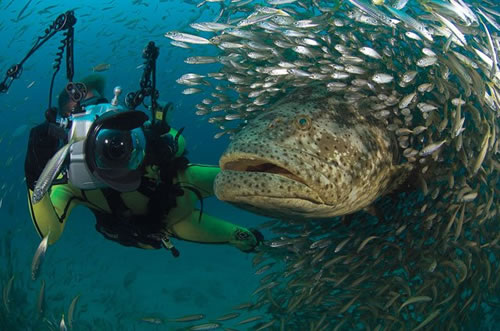
The next picture illustrates 'Bill Prentice' in his inflated diving suit, turning with shock when a grouper bumps into him and "shoves him forward a couple of feet". I researched the 'Goliath Grouper' and found it can grow to the size of a small car. No wonder Bill, in the story is worried.

Notice the colour wash used here is orange. Lilliput used a few colours in the magazine - predominantly black and white - and changed them month by month,; one month orange; one month pink and so on. I own a piece of art done by Sheppard in this orange colour but it was reproduced in blue! Presumably the editor selected one artist's work and then found he wanted to use another's but found it was a different colour and used a filter to change the colour for the photographic plates. Did he ask for orange one month, blue another, or did he merely hold inventory for use at a later date?


p. 14 Lilliput July 1956
A diver encounters a grouper
Photo: Michael Patrick O'Neill won the People in Nature Award with this
at the Nature's Best 2007 Photography Competition
[Taken from Alex Santoso's page]

In this story "Last Dive" by John Sidney, it's not really the sharks that cause a problem when searching for mother of pearl but the grouper! According to the Pura Divers website:
Goliath groupers, previously known as jewfish, were targeted by fishermen in uncontrolled numbers until 1990. This exploitation of the goliath grouper caused the International Union for Conservation of Nature (IUCN) to list it as critically endangered and the fishery was closed in 1990 

p. 16 Lilliput July 1956
A Tiger Shark circles a diver

The Tiger Shark is one of the three deadliest sharks but causes few fatalities in humans. Read more on the Hawaii Tiger Research Program page.

The second story I have found by "John Sidney" is in Lilliput September 1956 called "The toughest digestion in the world" and this is also illustrated by Raymond Sheppard


p. 15 Lilliput September 1956
A Shark swims amongst crates

p. 15 Lilliput September 19566
A Shark chases a porcupine fish

Why have I put "John Sidney" in speechmarks? The excellent Fiction magazine Index   states "John Sidney pseudonym of Dal Stivens, (1911-1997)". Under his pseudonym he wrote:

It also states
Stivens, Dal(las George) (1911-1997) (stories)
Writer. Born in Blayney, Australia.

Off I went and found he is considered "in the front ranks of Australia's short story writers" and 91 boxes of his papers are deposited with the National Library of Australia where you can also see a biographical sketch from which I have taken the material below.

He was born on the last day of 1911 and followed his father into bank accounting, but after his first collection of short stories were published in 1936 he moved on. It was his job of Press Officer at Australia House in London that led to his beginning to concentrate on writing articles and stories for the British, Australian and American markets and in 1958 he returned to his homeland. . "Stivens published several collections of his short stories and four novels, one of which, A horse of air, won the Miles Franklin Award in 1970. He also published a children's book, The bushranger (1978) and a book on natural history entitled The incredible egg. Stivens' fiction is widely admired for its humour and descriptions of the bush, especially his tall tales and cricketing stories". There is a 35-page tribute in Australian Folklore, No. 11, July 1996.
Dal Stivens died in Sydney on 15 June 1997.

Sunday, 1 June 2014

Raymond Sheppard and Blackie's Boys' Annual

John Tipper runs a 'group' on Facebook called "collectingbooksandmagazines" and he spotted a Raymond Sheppard illustration for me in a Blackie's Boys' Annual. He dated it 1938 and my copy has an inscription "September 1938" - as I've said before God bless those Grannies who added an inscription!

The cover of the annual was by D. C. Eyles i.e. Derek Charles Eyles (John Adcock has some more of his illustrations on his excellent blog and Geoff West has some artwork for sale on his Illustration Art Gallery). The first story in this annual is "A Spy in the Lines" by Clive Ryland - a good way of identifying editions of this series of books which tend to have no date.

Blackie's Boys' Annual 1938 Cover by D. C. Eyles
The picture John uploaded is this one of an elephant charging the reader. Interestingly the inserted illustration is on a glossy paper, just like the colour ones by other artists, but Sheppard's is in black and white! It accompanies the story "Moments with elephants" by Theodore Ruete. The author appears to have written around the turn of the 19th to 20th Century and mostly about African subjects - such as "Roads and bridges in Nigeria" in 1928, "Kenya, the cordage colony". An interesting reference turned up to an article in an academic journal to "Japan. The modern world's enigma".in Contemp. Rev. Nov., 1934. The last story I could find was "Northwards to the Nile" in The Pick of Boys' Stories, c.1935.


Blackie's Boys' Annual 1938 opposite p197
The leader of the herd
Note: this plate has number F96 on it

Christine Sheppard showed me the following in her collection of drawings and proofs from books and magazines and it's interesting to see how finished this looks and similar to the above

"Romance of ivory" story

If anyone recognises it I'd love to know where it appeared - especially as we have a clue, but I couldn't track down "romance of ivory" as a story or book title. Here's a sketch (kindly provided by Christine Sheppard) - one of many - where we can see that her father did a lot of studying to produce such authentic looking material.

Elephant head sketch by Raymond Sheppard

John didn't mention the other illustrations by Sheppard for another story,"Bundar, the Hooluck" by Arthur W. Strachan. Strachan's most durable work is Mauled by a Tiger: Encounters in the Indian Jungles in which we learn "this book will appeal to all those who have experienced the beauty and fascination of the Indian jungles", and how the author was mauled himself by a tiger and had two limbs amputated! Most editions have the illustrations drawn by Strachan himself.

Here are the illustrations for Strachan's story of Bundar, the gibbon who grows up from his mother's nursing to independence in the trees and in the interests of research I have read the story and was suprised to find it still as entertaining as I suspect it was 80 years ago. Hylobates Hooluck (or Hoolock) are the genus for the North Indian Gibbon


p.106 Quick as lightning the python struck
A snake catches a monkey as three others swing to safety


p.110 A narrow escape for Bundar
A leopard leaps at four monkeys

p. 113 He fought like a mad thing
Five monkeys with one attacking another

I have another Blackie's Boys' Annual Son and based on book titles advertised on the back cover it was published some time between 1931-1939 and the first story is called “The Camel's Hump”

Blackie's Boys' Annual 193? Cover by D. C. Eyles

Raymond Sheppard illustrated the story "The Saurian" by G. Prescott and from the images below you will see what is meant by 'saurian'.

Opposite p.48:
A luminous and gigantic crocodile was moving rapidly towards them
A crocodile approaches a hunter and "Sammy, his boy"
Note: this plate has number F467 on it
p.49 An oil drum was entangled in the tree's roots
Man in pith helmet points while native in fez looks on

p.50 Crocodile climbs over rock, out of the water

I also have a Blackie's Children's Annual and a copy of a Blackie's Girls' Annual but there for another time!