Tuesday, 8 January 2019

Raymond Sheppard and Picture Post (Part Two)

Picture Post 12 September 1953 pp. 32-33
In Part One of my look at Raymond Sheppard's work for the Picture Post magazine we looked at some of the Cold War stories, and today we're looking at two flyers and their war and post-war exploits - Neville Duke and Leonard Cheshire.

Cover of Picture Post 5 Sept 1953 showing Mara Lane

Firstly this lovely double page spread from Picture Post 5 September 1953 showing Neville Duke narrowly avoiding barrage balloons in his Miles Master (a training two-seater first flown in 1939). Duke became a famous test pilot and achieved the world air speed record in 1953, the year we read his story in Picture Post.

Picture Post 5 September 1953 pp24-25
The second double-page spread is unusual in that the editor (in my opinion) has chosen to extend the parachute straps across the left hand page. It might be on the original so I could be wrong! Anyway we see Duke and two of his crash landings!

Picture Post 5 September 1953 pp26-27

Picture Post 5 September 1953 p26

In the following issue Duke continues his story and we see him test flying his Hawker Hunter skidding to a halt and a fire engine racing towards him.

Picture Post 12 September 1953 pp.32-33

The next image drawn by Sheppard shows "at the time of my first supersonic bang, one country policeman was feeding his chickens" and we can see the results!

Picture Post 12 September 1953 pp.34

The 19 September issue has the third part of his story and shows Duke's admission that "I learned a sharp lesson", when he flew his Hawker N7/46, the prototype Seahawk at the 1949 Farnborough Air Show and relexed his guard a little too much nearly stalling the sircraft whilst inverted!

Picture Post 19 September 1953 p38-39
Now I'm skipping a few issues (saving the odds and ends for the next article in this series) and we're now looking at another famous post-war flyer. I quote Wikipedia:
Geoffrey Leonard Cheshire, Baron Cheshire, VC, OM, DSO & Two Bars, DFC (7 September 1917 – 31 July 1992) was a highly decorated Royal Air Force (RAF) pilot and group captain during the Second World War, and a philanthropist.
Among the honours Cheshire received as a pilot was the Victoria Cross, the highest award for gallantry in the face of the enemy that can be awarded to British and Commonwealth forces. He was the youngest group captain in the RAF and one of the most highly decorated pilots of the war.
After the war he founded a hospice that grew into the charity Leonard Cheshire Disability. He became known for his work in conflict resolution. In 1991 he was created a life peer in recognition of his charitable work
Reading the Wikipedia page is quite amazing, how much of a life he lived!  The first two parts of his story are not illustrated by Sheppard so I'm concentrating on parts three and four here. Part Three entitled "How he won his first D.S.O." is written by Russell Braddon and he tells us:
Pilot Officer Cheshire was at the controls of a crippled bomber. A grotesque figure, uniform in flames, screamed at him: "Fire! The tank's on fire." "Well, put it out then", snapped  Cheshire, who took the plane onto bomb Cologne and win the first of his three D.S.Os.

Picture Post 22 May 1954 p36-37

As if the story of his turning the plane round and hitting his original target on return was not enough, Cheshire was also involved in observing the Nagasaki bomb drop. "Destroyer becomes a crusader" is the title of part 4 of his story by Braddon and the full page black and white wash hits you in the face on turning the page!

Picture Post 29 May 1954 p33
The caption for this image states: "From the rear gunner's turret of a Flying Fortress, Cheshire watched the destruction of Nagasaki".  In an interview (on Youtube) Cheshire admits that the pilot of his aircraft should have been at 30,000 - not 39,000 feet, and should have been 10 miles away from the drop zone - not 50 miles. Yet he describes how the bomb had symmetry and thus showed it had 'controlled power' unlike other explosives he encountered which were 'ragged'. The whole interview is astounding and one of the reasons I like blogging - the many "rabbit holes" I go down as well as extraordianry art.

Next time: Picture Post and advertising

Monday, 29 October 2018

Raymond Sheppard and Picture Post (Part One)

14 February 1953

Stefan Lorant (February 22, 1901) was born in Budapest and died (November 14, 1997) in Rochester, Minnesota. His name doesn't roll off the tongue but his influence on pictorial journalism cannot be overstated. He moved from Hungary to Germany working in journalism, was chief editor of Münchner Illustrierte Presse and was known as a great stills photographer. Unfortunately his anti-Hitler stance led to his 'protective' imprisonment 6 weeks after Hitler came to power in 1933 and he returned to Hungary on release after months in prison. He then decided to move to England in 1934 where he created Weekly Illustrated (1934), Lilliput (1937), and after Sir Edward Hulton bought the Lilliput magazine in order to secure Lorant's services, Picture Post which was founded in 1938, a year before the outbreak of war. Lorant did research for a special edition of the Picture Post in America and decided to settle becoming a citizen in 1943.
 
Picture Post was famous for its portrayal of a variety of subjects and hard-hitting journalism. The photo spreads showed royalty and what we now call celebrities, but also, during the war, the ordinary person's struggles on the home front. Black and white photographs, printed clearly, allowed the population glimpses into how others were coping. During peace time many articles were educative and the magazine's fame (and copycat publications) were based on its photographs.It had an "initial print run of 750,000 and weekly sales peaking at 1,750,000 in 1939" (Anthony Quinn  (2016) A history of British Magazine Design)

Stefan Lorant: Godfather of photojournalism

So how did Raymond Sheppard have work appear in 1953, 1954 and then lastly 1956? I have no insights for you beyond the surprise that his work of illustration did appear in what is so famously known as a photographic magazine!

I want to look at some of the February, March and May issues of 1953 for this article and the later work at a later date.

Picture Post 14 February 1953 p.31

"Unsecret weapon" by John Steinbeck was a short story that appeared in the 14 February 1953 edition of Picture Post (and concluded the following week) . It tells the story of the narrator's pitch to President Roosevelt on breaking down tyranny (obviously at this point - communism) not by a frontal assault but by inward pressure. How? Using capitalism's greatest weapon...money! Counterfeit money would be dropped by balloons into Russia to break the money system once they had been discovered to be fake.


Picture Post 14 February 1953 p.32
"He could see the great white sphere shining in the moonlight"

Picture Post 14 February 1953 p.35
"It's – Comrade it's money"
The second part of this unusual story, which I can't see has ever appeared in reprint, appeared in Picture Post 21 February 1953

Picture Post 21 February 1953

Picture Post 21 February 1953 p.31
Comrade Radin charged around the corner
Picture Post 21 February 1953 p.33
Gemil was sealed from the world

Picture Post 21 February 1953 p.35
Tula read the sheaf of reports
The third issue in which Sheppard's illustrations appeared was 21 March 1953 with the article "I was Stalin's Bodyguard" by Achmed Amba.  The book about this Turkish man who joined the Soviet Army and became so close to Stalin was published in the UK in translation by Richard and Clara Winston in 1952 by Frederick Muller and serialised in Picture Post. (It should be said the authenticity of this account has now been called into question). In the same way the Kremlin drawing appears on page 35 (see below) the image was repeated all through the story.

Picture Post 21 March 1953

Picture Post 21 March 1953 p.35
NOTE: the cartoon on the right with a signature of "R.S." -
not Raymond Sheppard but the Lilliput regular Ronald Searle!

Picture Post 21 March 1953 p.35
The Kremlin

Picture Post 21 March 1953 p.36
He froze...then he said "Rosenholz, get out!"

Picture Post 21 March 1953 p.39
Stalin's oldest associate in the Government was Molotov

Picture Post 21 March 1953 p.43
Ulanova dancing
The next appearance of Sheppard's drawings was 16 May 1953 in an unusual image  for "Chiang and Red China" by Adlai Stevenson ("the man 27,00,00 Americans voted for"). The caption to the one illustration by Sheppard helpfully explains: "Chiang-Kai Shek's government is often pictured either with a halo or a forked tail". Sheppard has a pasted-up photographic portrait of Chiang-Kai Shek on his drawing showing the Chinese Nationalist Government leader stretching from Taiwan (then Formosa) to the mainland.

Picture Post 16 May 1953

Picture Post 16 May 1953 pp42-43

Picture Post 16 May 1953, p.43

It seems appropriate having concentrated on the Far East to end my first view of Raymond Sheppard's work in Picture Post here as the next article he illustrated was much closer to home.

Sunday, 29 July 2018

Raymond Sheppard and Fire in the flint

Dustjacket by Raymond Sheppard
A flint, chipped by an ancient Briton, to serve as a weapon against Roman invaders, is the link between the seven incidents in this story, which is set in Norfolk. From Roman times we follow its adventures until the day during the last war when it is lost for ever under the sea. Raymond Sheppard has drawn the jacket and contributed some brilliant illustrations.
This description is on the flyleaf of the dustjacket to this lovely book, which is similar to BB's "Lord of the forest" in that we track through history around a single object. In the latter it's the story told about an oak tree's life; in the former, it's a piece of flint.

Fire in the flint p.10
Ancient Briton's boat sinks as Roman galley approaches

In a review of another book, the Times ("Shorter Notices." 23 Oct. 1936: p.9) notes that with Robertson's book Zambesi Days that "Mr Roberston's experiences occurred in a fast passing age: he lived them unemotionally but appreciatively, and he has a natural gift of writing, a combination resulting in a most attractive volume". The SF Encyclopedia has biographical dates for Robertson:

Wilfrid Robertson
born Bakewell, Derbyshire: 22 April 1892
died Oxford, Oxfordshire: 5 April 1973

Beyond that I couldn't find any information on this author who was quite prolific in "big game hunter" and boy's adventure stories. He was obviously writing about the former from experience and, I would guess, having written so much about Rhodesia (now Zimbabwe), and other southern African countries, he might well have lived there for a period.

Fire in the flint p.20-21
The Icenis storm the Roman fort / Spear with flint attached

The first chapter follows the Iceni in "The finding of the flint" followed by "The heel of the Norman".
Fire in the flint p.26
Pushing blocks of stone uphill to build Norman castle

Fire in the flint p.37
Torfrid and Edgar save Norman knight from the marshes

Fire in the flint p.41
Norman knight rides off waving thanks

The expression "the fire in the flint" comes from Shakespeare's Timon of Athens (Act 1. Scene 1,30-31) "The fire in the flint Shows not till it be struck" and talks of the possibility of someone/something. Spurgeon, the evangelical preacher used the expression in some thoughts on the Book of Job "There's fire in the flint, cool as it looks; wait till the steel gets a knock at it, and you will see"

The next story "The country folk rise" tells of the Peasant Revolt
Fire in the flint p.48
The peasant's uprising in Norwich

Fire in the flint p.56
Two men jump into the moat

Fire in the flint p.61
The flint knife is broken
 This book contains a narrative following a single piece of flint through the ages, starting with the Iceni tribes in Norfolk and the Romans, and rapidly moves onto the rise and oppression of the Norman. Next comes the Peasant's Revolt.

The chapter called "The church breakers" tells of Cromwell's time and what was fascinating to me was that the churches in question are ones I have visited for an earlier blog series. 


Fire in the flint p.67
A farmer is ploughing when he hears the church bells pealing a warning

Fire in the flint p.75
Cromwell's sympathisers fall in the marshes

Fire in the flint p.78
A round-towered church (resembling Haddiscoechurch)
The next story "The harnessing of the marshes" tells of the draining and return to farmland of the marshes.
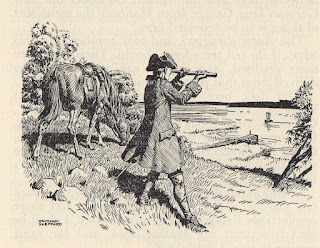
Fire in the flint p.82
He uses his spyglass to watch a boat sailing down the Yare river

Fire in the flint p.90
The workers escape the King's men in the fog

Fire in the flint p.92
The flint, stored in a caseing saves a gentleman's life
 "The wildfowlers" tells of those living on the marshes  and uses local dialect which reads beautifully.

Fire in the flint p.97
Two men catch "lemon sole" by a windmill

Fire in the flint p.105
Two men catch a thief

Fire in the flint p.106
The flint resides in a rifle

The last tale is "The losing of the flint"  and takes place during World War Two. Two German fighter pilots are captured by a fenlander, waving his old flintlock at them. He and a friend take the prisoners downriver and are in collison with their rescuers!

Fire in the flint p.109
A German plane crashes and its occupants captured

Fire in the flint p.111
A rescue launch, with no lights, collides with the row boat
The final illustration shows trout swimming over the flintlock whose "last remaining portion of the flint found a permanent resting-place beneath the primeval ooze"


WILFRID ROBERTSON BIBLIOGRAPHY
A Hunter talks. London: A.H. Stockwell, 1930
The Mountain of Gold. London; Glasgow: Blackie & Son, 1935.
Rhodesian Rancher. [Autobiographical reminiscences. With plates.]London; Glasgow: Blackie & Son, 1935.
Zambezi days  London; Glasgow: Blackie & Son, 1936.
The Painted Pool. London: Oxford University Press, 1936.
Raiders from the Bush. London: Oxford University Press, 1937.
The Black Planes [Illustrated by Jack Nicolle]. London: Oxford University Press, 1938.
The Scar on the Film, [Cover by Jack Nicolle] London: Oxford University Press, 1939. [a novel in which a civilization of ancient Phoenicians is discovered in Africa]
The day of Rorke's drift January 22, 1879 London: Oxford University Press, 1940.
Gold over the Border London : Oxford University Press, 1940.
The defence of Mafeking [Series: Great Exploits] London: Oxford University Press, 1941.
Wings over the Zambesi, London: Oxford University Press, 1941.
Dunkirk Dunes to Libyan Sand, London: Oxford University Press, 1941.
The Island Plot.[Illustrated by Lewis Lupton] London: Oxford University Press, [1942]
Lorraine Cross and Southern Cross London: Oxford University Press, [1943]
The Emperor's Ring. A story of the campaign in Abyssinia London: Oxford University Press, 1944.
The Affair of A.20. A story of the campaign in Madagascar London: Oxford University Press, 1945.
The Lost Gold Bars [Illustrated by S. Drigin]. London: Oxford University Press, 1946.
The Missing Legatee [Illustrated by Jack Matthew] London: Oxford University Press, 1947.
Coaster's Mate; An African Adventure  [Illustrated by Jack Matthew] London: Oxford University Press, 1949.
Trant of Makati London: Oxford University Press, 1949.
Bush Patrol [Illustrated by Jack Matthew] London: Oxford University Press, 1950.
The Storm of '96: a tale of the Mashona Rising [Illustrated by Jack Matthew] London: Oxford University Press, 1951.
The Zakana Gold Affair [Illustrated by Jack Matthew] London: Oxford University Press, 1952.
The Lost Mines of Chikova [Illustrated by Jack Mathew] London: Oxford University Press, 1954.
The Young Traveller in Tropical Africa. [With a map and 31 photographs]. London: Phoenix House, 1954.
The House on the Broads London: Quality Press, 1954.
Wagons rolling North : a story of Cecil Rhodes [Illustrated by J. S. Goodall] London: Phoenix House, 1954
The Blue Wagon [Illustrated by Jack Matthew] London: Oxford University Press, 1955.
Jack and the Elephant Bull. Oxford: Basil Blackwell, 1955
Queer Doings at Quantham. London; New York: Frederick Warne & Co., [1956]
Mandala Trail [Illustrated by Jack Matthew] London: Oxford University Press, 1956.
The Village by the Stones [Illustrated by Fred Exell] London: Phoenix House, 1957.
Snow on the Wold. London; New York: Frederick Warne & Co., [1957]
Mystery at Manthorpe London: J. M. Dent & Sons, 1957.
Fire in the Flint. A tale in seven scenes [Illustrated by Raymond Sheppard]. Oxford: Basil Blackwell, 1957.
Black Meg's London: J. M. Dent & Sons, 1958.
Shadow of a Rope  London: J. M. Dent & Sons, 1960.
Safari. London; Glasgow: Collins, 1961.
Coaster's Mate. London; Glasgow: Collins, 1961.
The House on the Headland [Illustrated by Geoffrey Whittam]. London: J. M. Dent & Sons, 1962.

SHORT STORIES
 Waiting (ss) The Oxford Annual for Boys 1935
“One White Night” (ss) The Citizen (Gloucester) May 3 1949
Better Value (ss) The Citizen (Gloucester) May 19 1949
Distant Fields Are Green (ss) The Citizen (Gloucester) Jun 17 1949
No Complaints (ss) The Citizen (Gloucester) Oct 5 1949
Floating Assets (ss) The Citizen (Gloucester) Oct 10 1949
Spice to Life (ss) The Citizen (Gloucester) Oct 20 1949
A Case for Compensation (ss) The Citizen (Gloucester) Jan 13 1950
Off the Ration (ss) The Citizen (Gloucester) Jan 25 1950
Black Outlook (ss) The Citizen (Gloucester) Feb 28 1950
Thought for the Morrow (ss) The Citizen (Gloucester) Mar 13 1950
The Porridge Pot (ss) The Citizen (Gloucester) Mar 17 1950
Guest Who Guessed (ss) The Citizen (Gloucester) Apr 13 1950
Labels Sometimes Lie (ss) The Citizen (Gloucester) May 23 1950
Patchwork Quilt (ss) The Citizen (Gloucester) Jun 26 1950 The above from the FiictionMags Index

 "Camp Craft in the African Wilds" in The Big Book for Boys. London: Humphrey Milford /Oxford University Press, 1937
[Unknown] in The Boys V for Victory Book 7. London: Oxford University Press, 1942
"Wet journey" in The Treasure Book of Comics. London: Odhams Press, 1955
"Two tales of Africa" in Stirring Stories for Boys [Ed: Eric Duthie] London: Odhams Press, 1960
"African Man-Eater" in Stirring Stories for Girls. [Ed: Eric Duthie] London: Odhams Press, 1963

OTHERS
"Madui's Curse" in Wide World Magazine, [Month unknown] 1933.
[Unknown] in Wide World Magazine, March 1944

Sunday, 20 May 2018

Raymond Sheppard and Pictorial Encyclopaedia of Scientific Knowledge

I wrote in 2012 how I was pointed to some - till then - unidentified artwork by Frank Bellamy which led to me discovering the two titles "The Pictorial Encyclopedia" and "The Pictorial History Book"

Well, a recent routine search led me to seeing, rather than reading about some Sheppard artwork about which I knew nothing and it appears in "The Pictorial Encylopaedia of Scientific Knowledge". I saw it in black and white, but knew, if it was the same series as mentioned, it would be in that strange "off colour", when it arrived. I ordered a copy - God bless Abebooks! I couldn't find a copy of one with its dustjacket, but online, in Spain of all places, I saw this:

Dustjacket and book

The Pictorial Encyclopaedia of Scientific Knowledge (Editorial board: Dr. Montagu H. Clifford, I. S. Dear,  Charles Harvey, E S Wolff) London: Sampson Low, Marston & Co., [1956]

The Pictorial Encyclopaedia of Scientific Knowledge, p6
This shows Sheppard credited

The Pictorial Encyclopaedia of Scientific Knowledge, p225

The Pictorial Encyclopaedia of Scientific Knowledge, p226

The Pictorial Encyclopaedia of Scientific Knowledge, p227
The Pictorial Encyclopaedia of Scientific Knowledge, p228

If you look very clearly, after clicking to enlarge the images, Sheppard clearly signed the work leaving me in no doubt!